
Vehicle Standard (Australian Design Rule 81/03 – Energy Consumption Labelling for Light Vehicles) 2025
I, CATHERINE KING, Minister for Infrastructure, Transport, Regional Development and Local Government determine this national road vehicle standard under section 12 of the Road Vehicle Standards Act 2018.
Dated: 18 November 2025
[SIGNED]
Catherine King
Minister for Infrastructure, Transport, Regional Development and Local Government
1.1. Name of Standard
1.1.1. This standard is the Vehicle Standard (Australian Design Rule 81/03 – Energy Consumption Labelling for Light Vehicles) 2025.
1.1.2. This standard may also be cited as Australian Design Rule 81/03 – Energy Consumption Labelling for Light Vehicles, the Australian Design Rule 81/03, or ADR 81/03.
1.2. Commencement
1.2.1. This standard commences on the day after it is registered.
- This vehicle standard prescribes the requirements for the measurement of fuel consumption, carbon dioxide emissions, energy consumption and range, and the design and fitment of energy consumption labels to light vehicles.
3.1. This vehicle standard applies to MA, MB, MC, MD and NA category vehicles with a gross vehicle mass not exceeding 3,500kg from the dates set out in clauses 3.1.1 to 3.1.2 and the table in clause 3.4.
3.1.1 1 July 2026 for new models.
3.1.2 1 July 2028 for all models.
3.2. This vehicle standard also applies to NB1 category vehicles and MA, MB, MC, MD category vehicles with a gross vehicle mass exceeding 3,500kg, from the dates set out in clauses 3.1.1 to 3.1.2 and the table in clause 3.4, if the vehicle is fitted with a label containing information on the vehicle’s fuel consumption, carbon dioxide emissions, energy consumption and/or battery range.
3.3 For the purposes of clause 3.1.1 above, a “new model” is a vehicle model first produced with a ‘Date of Manufacture’ on or after the agreed date in that clause.
3.4 Applicability Table
Vehicle Category | ADR Category Code | UN Category Code* | Manufactured on or After | Acceptable Prior Rules |
Moped 2 wheels | LA | L1 | Not Applicable | |
Moped 3 wheels | LB | L2 | Not Applicable | |
Motor cycle | LC | L3 | Not Applicable | |
Motor cycle and sidecar | LD | L4 | Not Applicable | |
Motor tricycle | LE | L5 | | |
| LEM | | Not Applicable | |
| LEP | | Not Applicable | |
| LEG | | Not Applicable | |
Passenger car | MA | M1 | See clauses 3.1.1 to 3.1.2 | Nil |
Forward-control passenger vehicle | MB | M1 | See clauses 3.1.1 to 3.1.2 | Nil |
Off-road passenger vehicle | MC | M1 | See clauses 3.1.1 to 3.1.2 | Nil |
Light omnibus | MD | M2 | | |
| up to 3.5 tonnes ‘GVM’ and up to 12 seats | MD1 | | See clauses 3.1.1 to 3.1.2 | Nil |
| up to 3.5 tonnes ‘GVM’ and more than 12 seats | MD2 | | See clauses 3.1.1 to 3.1.2 | Nil |
| over 3.5 tonnes and up to 4.5 tonnes ‘GVM’ | MD3 | | See clause 3.2 | Nil |
| over 4.5 tonnes and up to 5 tonnes ‘GVM’ | MD4 | | Not Applicable | |
Heavy omnibus | ME | M3 | Not Applicable | |
Light goods vehicle | NA | N1 | See clauses 3.1.1 and 3.1.2 | Nil |
Medium goods vehicle | NB | N2 | | |
| over 3.5 tonnes up to 4.5 tonnes ‘GVM’ | NB1 | | See clause 3.2 | Nil |
| over 4.5 tonnes up to 12 tonnes ‘GVM’ | NB2 | | Not Applicable | |
Heavy goods vehicle | NC | N3 | Not Applicable | |
Very light trailer | TA | O1 | Not Applicable | |
Light trailer | TB | O2 | Not Applicable | |
Medium trailer | TC | O3 | Not Applicable | |
Heavy trailer | TD | O4 | Not Applicable | |
4.1. Supporting Information has the same meaning as in the Road Vehicle Standards Rules 2019.
4.2 For all other vehicle categories, definitions and meanings used in this standard, refer to Vehicle Standard (Australian Design Rule 111/00 – Advanced Emission Control for Light Vehicles) 2024.
4.3. If the term is not is defined in ADR 111/00, refer to the Vehicle Standard (Australian Design Rule – Definitions and Vehicle Categories) 2005.
5.1 All vehicles must have their fuel consumption and carbon dioxide emissions tested in accordance with ADR 111/00, or one of the alternative standards specified in clause 7.
5.2 If the vehicle is a Pure Electric Vehicle, or an OVC-HEV, or an OVC-FCHV, the vehicle must also have its energy consumption and range tested in accordance with ADR 111/00, or one of the alternative standards specified in clause 7.
5.3 The manufacturer must record the following in their Supporting Information:
5.3.1 the carbon dioxide emissions value declared for the vehicle (in grams per kilometre);
5.3.2 the carbon dioxide emissions measured for the vehicle over the complete test cycle (in grams per kilometre);
5.3.3 the fuel consumption value declared for the vehicle (in litres per 100 kilometres or kilograms per 100 kilometres, as appropriate for the fuel type); and
5.3.4 the fuel consumption measured for the vehicle over the complete test cycle (in litres per 100 kilometres or kilograms per 100 kilometres, as appropriate for the fuel type).
5.3.5 If the vehicle is an OVC-HEV, or an OVC-FCHV, the manufacturer must also record:
5.3.5.1 the carbon dioxide emissions value declared for the vehicle in charge sustaining mode (in grams per kilometre);
5.3.5.2 the carbon dioxide emissions measured for the vehicle over the complete test cycle in charge sustaining mode (in grams per kilometre);
5.3.5.3 the fuel consumption value declared for the vehicle in charge sustaining model (in litres per 100 kilometres or kilograms per 100 kilometres, as appropriate for the fuel type);
5.3.5.4 the fuel consumption measured for the vehicle over the complete test cycle in charge sustaining mode (in litres per 100 kilometres or kilograms per 100 kilometres, as appropriate for the fuel type).
5.3.5.5. the equivalent all electric range declared for the vehicle (in kilometres); and
5.3.5.6 the equivalent all electric range measured for the vehicle over the complete test cycle (in kilometres);
5.3.5.7 the energy consumption value declared for the vehicle (in watt hours per kilometre); and
5.3.5.8 the energy consumption value measured for the vehicle over the complete test cycle (in watt hours per kilometre).
5.3.6 If the vehicle is a Pure Electric Vehicle, the manufacturer must also record:
5.3.6.1. The range declared for the vehicle (in kilometres); and
5.3.6.2 The range measured for the vehicle over the complete test cycle (in kilometres); and
5.3.6.3 The energy consumption value declared for the vehicle (in watt hours per kilometre); and
5.3.6.4 The energy consumption value measured for the vehicle over the complete test cycle (in watt hours per kilometre).
5.3.7 If the vehicle is an MA, MB, MC, NA or NB1 category vehicle, the manufacturer must also record the NEDC equivalent carbon dioxide emissions value calculated for the vehicle in accordance with Appendix B or the alternative procedures specified in clause 6 (in grams per kilometre and rounded to the nearest whole number).
5.4 Vehicles must be fitted with an Energy Consumption Label that meets the applicable requirements of clauses 5.3 to 5.7 and the specifications in Appendix A.
5.5 The label must be fitted on the lower left (passenger side) corner of the windscreen from the inside of the vehicle.
5.6 The energy consumption label fitted to the vehicle must display:
5.6.1 the fuel consumption value declared for the vehicle to comply with clause 5.3.4; and
5.6.2 the tailpipe carbon dioxide emissions value declared for the vehicle to comply with clause 5.3.1
5.7 If the vehicle is a Pure Electric Vehicle, or an OVC-HEV, or an OVC-FCHV, the energy consumption label fitted to the vehicle must also display:
5.7.1 the electric energy consumption declared for the vehicle to comply with clause 5.3.5.7 or 5.3.6.3 (as applicable for the vehicle type); and
5.7.2 the battery range declared for the vehicle to comply with clause 5.3.5.5 or 5.3.6.1 (as applicable for the vehicle type).
6. EXEMPTIONS AND ALTERNATIVE PROCEDURES
6.1 At the choice of the manufacturer, the NEDC equivalent carbon dioxide emissions value required under clause 5.3.7 may be determined by testing the vehicle in accordance with the complete Type I test specified in United Nations (UN) Regulation No. 101 - Uniform provisions concerning the approval of passenger cars powered by an internal combustion engine only, or powered by a hybrid electric power train with regard to the measurement of the emission of carbon dioxide and fuel consumption and/or the measurement of electric energy consumption and electric range, and of categories M1 and N1 vehicles powered by an electric power train only with regard to the measurement of electric energy consumption and electric range, incorporating all amendments up to and including Supplement 12 to the 01 series of amendments or later, in lieu of the procedure specified in Appendix B of this vehicle standard.
6.1.1 Notwithstanding the scope of UN Regulation No. 101, a test report for a vehicle with a reference mass exceeding 2,610kg or a gross vehicle mass over 3,500kg tested in accordance with UN Regulation No. 101 is acceptable as evidence of compliance with clause 5.3.7 of this vehicle standard.
7.1 The technical requirements of Annexes B1 to B8 of United Nations Regulation No. 154 - Uniform provisions concerning the approval of light duty passenger and commercial vehicles with regards to criteria emissions, emissions of carbon dioxide and fuel consumption and/or the measurement of electric energy consumption and electric range (WLTP).
7.2 The technical requirements of Annex XXI of Commission Regulation (EC) 2017/1151 of the European Parliament and of the Council of 1 June 2017 supplementing Regulation (EC) No 715/2007 of the European Parliament and of the Council on type-approval of motor vehicles with respect to emissions from light passenger and commercial vehicles (Euro 5 and Euro 6) and on access to vehicle repair and maintenance information, amending Directive 2007/46/EC of the European Parliament and of the Council, Commission Regulation (EC) No 692/2008 and Commission Regulation (EU) No 1230/2012 and repealing Commission Regulation (EC) No 692/2008.
7.3 The technical requirements of Annex XXI of Commission Implementing Regulation (EU) 2025/1706 of 25 July 2025 laying down rules, procedures and testing methodologies for the application of Regulation (EU) 2024/1257 as regards exhaust and evaporative emission type-approval of vehicles of categories M1 and N1 and amending Implementing Regulation (EU) 2020/683.
7.4 Subject to 7.4.1 to 7.4.2, the technical requirements of Title 40 the United States Code of Federal Regulations (CFR), Part 600, Fuel Economy and Greenhous Gas Exhaust Emissions of Motor Vehicles.
7.4.1 The fuel consumption value declared for the vehicle must be determined in accordance with § 600.210-12.
7.4.2 The carbon dioxide emissions value declared for the vehicle must be determined in accordance with § 600.210-12.
7.4.3 The energy consumption value declared for the vehicle must be determined in accordance with § 600.116-12.
7.4.4 The range value declared for the vehicle must be determined in accordance with § 600.116-12.
14.3 fuel type of the vehicle, where:
14.3.3 for Pure Electric Vehicles, the term ‘Electric’ must be used for the fuel type;
14.3.4 for OVC-HEVs, the terms “Petrol Plug-in Hybrid”, “Diesel Plug-in Hybrid”, “LPG Plug-in Hybrid” or “Hydrogen Combustion Plug-in Hybrid” must be used, as appropriate, for the fuel type;
14.3.5 for Fuel Cell Vehicles, the term ‘Hydrogen Fuel Cell’ must be used for the fuel type;
14.3.6 for NOVC-HFCVs, the term ‘Hydrogen Fuel Cell Hybrid’ must be used for the fuel type; and
14.3.7 for OVC-FCHVs, the term ‘Hydrogen Fuel Cell Plug-in Hybrid’ must be used for the fuel type.
15. The fuel consumption value declared for the vehicle must be centred in the red area on the label indicated by the letters “XX.X” in Figure 1 or Figure 2, as appropriate for the vehicle type.
15.1 for Pure Electric Vehicles, the value must be displayed as “0”.
15.2 for all other vehicles the value must be as specified for the vehicle type in clause 5.3.4 of this vehicle standard;
16. The tailpipe CO2 emissions value in must be centred in the red area of the label indicated by the letters “XXX” in Figure 1 for vehicles with a CO2 value greater than 50 grams per kilometre; or the green area of the label indicated by the letters “XX” in Figure 2 for vehicles with a CO2 value less than 50 grams per kilometre.
16.1 for all vehicles powered or charged exclusively by electricity and/or hydrogen, the value must be displayed as “0”.
16.2 for all other vehicles, the value must be as specified for the vehicle type in clause 5.3.1 of this vehicle standard;
17. The electric energy consumption value must be centred in the red area on the label indicated by the letters “XXX” in Figure 1 or Figure 2, as appropriate for the vehicle type.
17.1 for OVC-HEVs and OVC-FCHVs, the value must be as specified for the vehicle type in clause 5.3.5.7 of this vehicle standard; and
17.2 for Pure Electric Vehicles the value must be as specified for the vehicle type in clause 5.3.6.3 of this vehicle standard; and
17.3 for all other vehicles, the value is to be displayed as “NA”;
18.1 for OVC-HEVs and OVC-FCHVs, the value must be as specified for the vehicle type in clause 5.3.5.5 of this vehicle standard; and
18.2 for Pure Electric Vehicles the value must be as specified for the vehicle type in clause 5.3.6.1 of this vehicle standard; and
18.3 for all other vehicles, the value is to be displayed as “NA”;

Figure 1: Illustration of Energy Consumption Label with fonts and dimensions

Figure 2: Illustration of Energy Consumption Label for vehicles with CO2 emissions less than or equal to 50 grams per kilometre with fonts and dimensions

Figure 3: Illustration of Energy Consumption Label
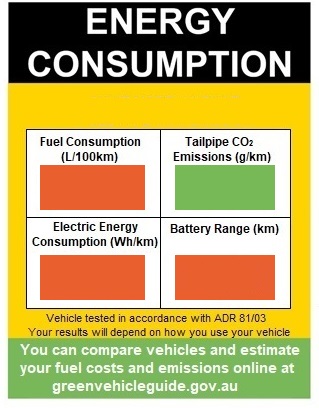
Figure 4: Illustration of Energy Consumption Label for vehicles with CO2 emissions less than or equal to 50 grams per kilometre

Figure 5: Sample Energy Consumption Label (for illustrative purposes only)
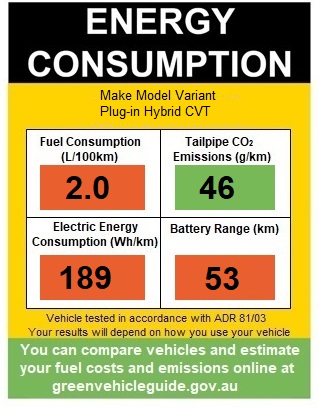
Figure 6: Sample Energy Consumption Label for vehicles with CO2 emissions less than or equal to 50 grams per kilometre (for illustrative purposes only)
Calculation of NEDC equivalent carbon dioxide value for vehicles tested to the WLTP or US EPA test cycle
- Introduction
This appendix specifies an approved method for calculating an NEDC equivalent carbon dioxide emissions and fuel consumption value for the purposes of clause 5.3.7 of this vehicle standard.
- Definitions
4-phase WLTP means a vehicle with a carbon dioxide emissions value determined over the complete cycle of the WLTP as adopted in Annex XXI of EU Regulation 2017/1151 or EU Regulation 2025/1706 or Level 1A or Level 2 of UN Regulation No.154.
3-phase WLTP means a vehicle with a carbon dioxide emissions value determined over the complete cycle of the WLTP as adopted in Level 1B of UN Regulation No.154.
US 2-cycle test procedure means a vehicle with a carbon dioxide emissions value determined over the ‘Federal Test Procedure’ and the ‘Highway Fuel Economy Test’ specified in Title 40 of the United States Code of Federal Regulations, Part 600 – Fuel Economy and Greenhouse Gas Exhaust Emissions of Motor Vehicles.
3. Calculation of an NEDC equivalent carbon dioxide emissions value for Pure ICE vehicles and NOVC-HEVs
3.1 Pure ICE vehicles and NOVC-HEVs with a carbon dioxide emissions value determined in accordance with the ‘4-phase WLTP’, ‘3-phase WLTP’ or the ‘US 2-cycle’ test procedure, may use the following equation to calculate the vehicle’s NEDC equivalent carbon dioxide emissions value for the purposes of this vehicle standard:

Where:
 is the NEDC equivalent carbon dioxide emissions value in grams per kilometre (g/km)
 is the carbon dioxide emissions value (in g/km) determined over the original test procedure
Parameters a and b are defined in Table B1 depending on the procedure used for determining the reported carbon dioxide emissions value determined over the original test procedure, vehicle category, and fuel type.
Table B1: Parameters a and b for the conversion of carbon dioxide emission values of Pure ICE vehicles and NOVC-HEVs.
Original test procedure | ADR vehicle category | Fuel type | a | b |
Vehicles tested in accordance with the 4 phase WLTP | MA, MB, MC | Petrol | 0.9294 | -13.2248 |
NA, NB1 | Petrol | 0.9294 | -13.2248 |
MA, MB, MC | Diesel | 0.8075 | 1.8475 |
NA, NB1 | Diesel | 0.7633 | 1.0199 |
Vehicles tested in accordance with the 3 phase WLTP | MA, MB, MC | Petrol | 0.7946 | 11.8702 |
NA, NB1 | Petrol | 0.7946 | 11.8702 |
MA, MB, MC | Diesel | 0.7773 | 10.0080 |
NA, NB1 | Diesel | 0.7347 | 8.7332 |
Vehicles tested in accordance with the US 2-cycle test procedure | MA, MB, MC | Petrol | 0.9849 | 0.9819 |
NA, NB1 | Petrol | 0.9849 | 0.9819 |
MA, MB, MC | Diesel | 1.0478 | -3.0061 |
NA, NB1 | Diesel | 1.0419 | -3.2551 |
4. Calculation of an NEDC equivalent carbon dioxide emissions value for OVC-HEVs
4.1 If the vehicle is an OVC-HEV, the following procedure may be used to determine the vehicle’s NEDC equivalent carbon dioxide emissions value:
4.1.1 The declared charge sustaining CO2 emissions value from the original test procedure may be converted to a NEDC equivalent charge sustaining CO2 emissions value  using the following equation:

Where:
 is the carbon dioxide emissions value (in g/km) determined over the original test procedure
Parameters a and b are defined in Table B1 depending on the procedure used for determining the reported carbon dioxide emissions value determined over the original test procedure, vehicle category, and fuel type of the internal combustion engine.
4.1.2 The NEDC equivalent carbon dioxide emissions value ( for the vehicle shall then be calculated using the following equation

Where:
 is the NEDC equivalent charge-sustaining CO2 emissions value in g/km determined in accordance with clause 4.2.1
EAER is the equivalent all-electric range determined in accordance with the original test procedure in km
4.2 At the choice of the manufacturer, an OVC-HEV tested in accordance with the ‘4-phase WLTP’, with a utility factor weighted carbon dioxide emissions value calculated using:
a. the dn utility factor curve specified in Annex B8-Appendix 5 of the 00 or 01 series of UN Regulation No. 154, or EU Regulation 2017/1151; or
b. the dnea utility factor curve specified in Annex B8-Appendix 5 of Level 1A or Level 2 of UN Regulation No. 154, or EU Regulation 2023/443;
the vehicle’s NEDC equivalent carbon dioxide emissions value may be calculated using the following equation:
Where:
is the NEDC equivalent carbon dioxide emissions value in g/km
is the carbon dioxide emissions value declared in accordance with the original test procedure
Parameters a and b are defined in Table B2 depending on the procedure used for determining the reported declared carbon dioxide emissions value, the vehicle category, and the fuel type of the internal combustion engine.
Table B2: Parameters a and b for the conversion of carbon dioxide emission values of off-vehicle charging hybrid electric vehicles (OVC-HEVs).
Original test procedure | ADR vehicle category | Fuel type | a | b |
OVC-HEVs tested in accordance with the 4 phase WLTP, with a utility factor weighted CO2 value calculated using: the dn (Euro 6d) utility factor curve specified in Annex B8-Appendix 5 of the 00 or 01 series of UN Regulation No. 154 (Level 1A or Level 2), or EU Regulation 2017/1151 as amended by EU Regulation 2018/1832; or the dnea (Euro 6e-EA) utility factor curve specified in Annex B8-Appendix 5 of UN Regulation No. 154 (Level 1A or Level 2), or EU Regulation 2017/1151 as amended by EU Regulation 2023/443. | MA, MB, MC | Petrol | 0.6879 | 13.9135 |
NA, NB1 | Petrol | 0.6879 | 13.9135 |
MA, MB, MC | Diesel | 0.7084 | 14.5883 |
NA, NB1 | Diesel | 0.7084 | 14.5883 |
- Supporting information requirements
5.1 For each vehicle type reporting a carbon dioxide or fuel consumption value determined in accordance with this Appendix, the following information must be recorded in the manufacturer’s Supporting Information:
5.1.1 the vehicle’s NEDC equivalent carbon dioxide emissions value (in g/km) determined in accordance with clause 3.1, 4.1 or 4.2;
5.1.2 The vehicle’s carbon dioxide emissions value (in g/km) determined in accordance with the original test procedure; and
5.1.3 the vehicle’s ADR vehicle category; and
5.1.4 the fuel-type for the vehicle’s internal combustion engine (“petrol” or “diesel”); and
5.1.5 the vehicle’s powertrain type (“Pure ICE vehicle”, “NOVC-HEV” or “OVC-HEV”).
5.2. If the vehicle is an OVC-HEV with an NEDC equivalent CO2 value determined in accordance with clause 4.1 of this Appendix, the following information must also be recorded in the manufacturer’s Supporting Information:
5.2.1 The vehicle’s charge sustaining carbon dioxide emissions value in g/km, determined in accordance with the original test procedure;
5.2.2. the vehicle’s NEDC equivalent charge sustaining carbon dioxide emissions value emissions (in g/km), calculated in accordance with clause 3.1;
5.2.3 the vehicle’s equivalent all electric range in km, determined in accordance with the original test procedure.