
Mawson Station
Heritage Management Plan 2014 – 2019

ISBN: 978-1876934262
This publication is available on the internet at: http://aad.gov.au/.
It is also available from the Department of the Environment at ciu@environment.gov.au
or freecall 1800 803 772.
This publication should be cited as: Commonwealth of Australia (2014). Mawson Station Heritage Management Plan 2014-2019, Department of the Environment, Canberra.
© Commonwealth of Australia 2014
This work is copyright. You may download, display, print and reproduce this material in unaltered form only (retaining this notice) for your personal, non-commercial use or use within your organisation. Apart from any use as permitted under the Copyright Act 1968, all other rights are reserved. Requests and enquiries concerning reproduction and rights should be addressed to Department of the Environment, Public Affairs, GPO Box 787, Canberra ACT 2601 or email public.affairs@environment.gov.au.
Disclaimer
The contents of this document have been compiled using a range of source materials and are valid as at 19 November 2014. The Australian Government is not liable for any loss or damage that may be occasioned directly or indirectly through the use of or reliance on the contents of the document.
Contents
Executive summary 5
- Introduction 7
1.1 The need for a Mawson heritage management plan 7
1.2 Objectives and conservation philosophy 7 - Mawson station – an overview 8
2.1 Environment 8
2.2 History – discoveries, station foundation, redevelopment 10
2.3 Extant old structures 13
2.4 Current uses 17 - Commonwealth Heritage values 20
- Condition of Commonwealth Heritage values 21
4.1 Condition of significant heritage fabric 21
4.2 Condition of Commonwealth Heritage values 22 - Management framework 25
5.1 Site governance 25
5.2 Environment Protection and Biodiversity Conservation Act 1999 25
5.3 Antarctic Treaty Environment Protection Act 1980 25
5.4 Protection of Movable Cultural Heritage Act 1986 26 - Management goals and constraints 27
6.1 Goals 27
6.2 Pressures on Commonwealth Heritage values 27 - Management policies 31
- Implementation plan 35
8.1 Fabric conservation and building adaptation or demolition works 36
8.2 Objects and collections management 36
8.3 Interpretation 35
8.4 Research and assessment 36
8.5 Records management 36
8.6 Monitoring and review of the plan 36
References 37
Appendixes 39
- Building images 39
- Statements of significance 54
- ATCM Resolution 5 Guidelines for handling pre-1958 historic remains whose
existence or present location is not known 59
Figures
1. Mawson from the air 9
2. Map of Mawson buildings and structures 19
Tables
1. Summary of significant building types 16
2. Validation of the relevance of the Commonwealth Heritage values identified in 2004 20
3. Condition and integrity of the fabric 23
4. Condition of heritage values 24
5. Forecast future of early buildings and structures 28
Executive summary
Mawson, in Mac.Robertson Land, Australian Antarctic Territory, was established in 1954 and is the oldest Australian Antarctic station and the oldest continually occupied station south of the Antarctic Circle. Its buildings show an evolution of polar construction methods no longer evidenced at Davis and Casey. ‘Mawson station’ was listed on the Register of the National Estate in 2001 and transferred to the Commonwealth Heritage List in 2004.
The Environment Protection and Biodiversity Conservation Act 1999 (EPBC Act) requires that a plan is prepared to provide for the protection and management of the values of listed sites. This management plan will provide such a framework as Mawson continues to evolve consistent with the requirements of supporting contemporary scientific endeavour. The plan is premised on the availability of only finite resources to conserve representative values and fabric in extreme environments, and in turn the need for the eventual removal of structures that cannot reasonably be made to play an active role in contemporary station life.
1. Introduction
1.1 The need for a Mawson heritage management plan
Mawson is the oldest Australian Antarctic station and is the oldest continually occupied station south of the Antarctic Circle. It is managed by the Australian Antarctic Division (AAD) of the Department of Sustainability, Environment, Water, Population and Communities and was included on the Commonwealth Heritage List in 2004.
Mawson demonstrates the evolution of building methods in Antarctica. The buildings pre-dating the 1980s also provide insights into early station life.
This management plan has been prepared in accordance with the Environment Protection and Biodiversity Conservation (EPBC) Act 1999 and Regulations. It is a tool to assist in ensuring that the statutory obligations for managing this Commonwealth Heritage site are met, and it has been structured in accordance with the guidelines for Management Plans for Places on the Commonwealth Heritage List (DEH 2006).
The plan focuses on the buildings and structures associated with the early era of station operations. Many of these buildings are not occupied and do not have an active role in present day station life.
1.2 Objectives and conservation philosophy
This plan has been developed to provide a framework for on and off site actions to identify, protect, conserve and transmit the Commonwealth Heritage values of Mawson – the heritage of Mawson should be valued, protected and understood.
Valued: The buildings of Mawson reflect the evolution of Antarctic construction methods spanning several decades. Retained buildings need to form a useful and important role in modern station life.
Protected: Interventions should protect and conserve the integrity of the station’s heritage features. Decisions and priorities will be guided by an understanding of the features and the type of use that made each building significant.
Understood: Interpretation activities should enrich the experience and understanding of Mawson by AAD staff, other Australian Antarctic program personnel and the broader community.
2. Mawson station – an overview
2.1 Environment
Mawson (67°36'S, 62°53'E) lies some 5200 km south-south-west of Perth and occupies an ice-free rock outcrop 900 m x 700 m (63 ha) on the south-eastern shore of Horseshoe Harbour, in Holme Bay, Mac.Robertson Land (Figure 1). It is the oldest, continuously occupied facility south of the Antarctic circle. Resupply vessels usually anchor within 100 m of the outcrop. The station site rises to 33 m above sea level. To the east and west are steep ice cliffs from which small icebergs calve.
The local geology is made up of ice-polished, moraine-mantled granite (charnockite) known as Mawson Rock. There are few flat areas, and roche moutonnées formed by past northward movement of ice have produced a micro-topography of smooth southern slopes and step-like cliff-lets on the northern aspect.
Within 35 km inland of Mawson the surface of the ice sheet rises to around 1000 m above sea level. From about 15 to 50 km south and south-west, four parallel narrow chains of nunataks collectively known as the Framnes Mountains (Mount Henderson and the Masson, David and Casey Ranges) project 300 to 400 m above the ice sheet and from 900 m to 1500 m above sea level.
The area’s terrestrial vegetation is limited to non-marine algae, mosses and lichens. Mosses (Bryum pseudo-triquetrum, Grimmia lawiana and Grimmia antarctici) typically form cushions, turfs or hummocks in gravels with northerly aspects and in the path of melt water. Twenty-one species of lichen have been recorded. The most common are Buellia frigida and Xanthoria elegans.
Weddell seals (Leptonychotes weddelli) are common near the station, at coastal islands and at tide cracks in the sea ice during late spring and early summer. Leopard seals (Hydrurga leptonyx) are occasionally seen on the sea ice, and crabeater seals (Lobodon carcinophagus) are present in small numbers offshore. Antarctic fur seals (Arctocephalus gazelle), elephant seals (Mirounga leonina) and Ross seals (Ommatophoca rossi) have been recorded in the wider region.
Although the area is not considered a significant breeding area or access route for birds, Wilson’s storm petrels (Oceanites oceanicus), snow petrels (Pagodroma nivea), and emperor penguins (Aptenodytes fosteri) have bred within the station area. Adélie penguins (Pygoscelis adeliae), Antarctic petrels (Thalassoica antarctica), Cape petrels (Daption capense), Southern giant petrels (Macronectes giganteus), Antarctic fulmars (Fulmarus glacialoides) and Antarctic skuas (Catharacta maccormickii) have also been reported.
Mean monthly temperatures at Mawson range from +0.1°C in January to -18.8°C in August, with extremes of +10.6°C and -36.0°C. The mean annual wind speed is 10.9 m/sec with frequent prolonged periods of strong south-easterly katabatic winds from the ice cap. Gusts often exceed 50 m/sec. The region is characterised by high cloudiness throughout the year, very low absolute humidity, low precipitation and frequent periods of intensified winds, drifting snow and low visibility associated with the passage of major low pressure systems.

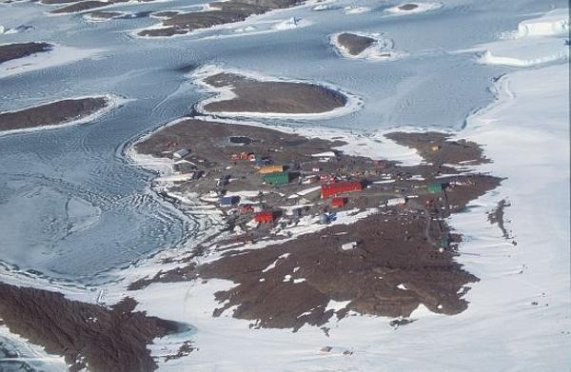
Figure 1. Mawson (top – D. McVeigh, 2004; bottom – W. Papps, 2000).
2.2 History
Discoveries
The coast where the station is built was sighted by Sir Douglas Mawson on 1 January 1930. Mawson led the first British, Australian and New Zealand Antarctic Expedition (BANZARE) to the continent, aboard the Discovery, making a reconnaissance flight over the region and naming the coast after Macpherson Robertson, a chocolate manufacturer who was also a keen patron of Australian Antarctic exploration.
On 13 January 1930 a cairn and flag pole were erected on a coastal island and the area proclaimed British Territory. Mawson named the site Proclamation Island. He took similar actions during the second BANZARE voyage (1930‑31) – throwing a cylinder containing a proclamation onto the rocks at Murray Monolith on 13 February 1931. Later that day a flag was hoisted at Scullin Monolith and in the following week, Mawson’s party landed at Cape Bruce and once again left behind a flag and proclamation. Two vast sectors of the Antarctic continent formally became the Australian Antarctic Territory in 1933.
In the same decade, Norwegian explorers financed by the ship owner and whaling magnate Lars Christensen were also active in the area. They named a number of features, including the Framnes Mountains. Then, between 1946 and 1947 the United States’ Operation Highjump expeditions photographed the coast from the air. Mawson pointed to these nations’ interests in the Australian sector when convincing the Australian Government to establish a station. His preference was for a station in George V Land, the site of the main base of Mawson’s 1911-1914 expedition.
Initial Australian efforts to reconnoitre the Antarctic coastline with a view to establishing a permanent base failed due to the lack of a ship suited to heavy ice conditions. In 1947, Australian National Antarctic Research Expedition (ANARE) stations were established on Heard and Macquarie Islands however HMAS Wyatt Earp failed to penetrate far enough into sea ice to take the first step towards establishing a continental base.
By 1953, the inaugural Antarctic Division director, Dr Phillip Law, drew on American photographs and Norwegian charts to propose Horseshoe Harbour as a priority site to assess with a view to establishing a year-round station on rock. Australia became the fourth nation to have a permanent presence on the continent, after Britain, Argentina and Chile.
Station foundation
Law obtained approval to mount a small expedition to East Antarctica in early 1954 aboard the Danish ice-strengthened ship Kista Dan. The ship collected men and dogs from Heard Island, and on arrival confirmed that the Horseshoe Harbour site was suitable. On 13 February 1954, a party led by Law arrived with aircraft, supplies and six huts and raised the Australian flag. In a formal ceremony, in the name of Queen Elizabeth II and the Government of the Commonwealth of Australia, Law named the fledgling station in honour of Mawson.
The men were to share two ‘barge caravans’ until their living quarters were erected. The caravans were mounted on steel-sheeted runners and designed to float. They were designed by the first officer-in-charge (station leader) Bob Dovers, based on sleds used by the French in Adélie Land.
The first three buildings—the Electricians’ Workshop, used by the officer-in-charge (OIC), the meteorologist and radio operator; the Electrical Store; and the Field Store (now removed)—were finished in the ten days before the ship departed. These Australian-designed aluminium-clad panel buildings could be erected in a day and were to become the preferred construction method throughout the Antarctic.
The first wintering party of ten members erected three other buildings, one of which remains—the living quarters – Biscoe Hut. Biscoe is the only timber frame and timber board clad structure to be erected on an Australian station. It was manufactured in Norway for the Norwegian-Swedish-British Antarctic Expedition. When it was not able to be transported to Maudheim it was left in Cape Town where it was purchased for use at Mawson.
Makeshift maintenance was constantly required, equipment was trialled with varying degrees of success, and the long winter was punctuated by arduous field sorties. Australia’s interests in the Antarctic matured and the station came to be viewed as permanent rather than an annual prospect. Ten more huts were erected during the hand-over to the OIC of
the 1955 Mawson party, John Béchervaise. From 1957, the station hub centred on ‘Coronation St’ – Weddell hut, Shackleton hut, the Mess, Wilkins hut, Ross hut and Law hut. It was during this period that the station began to take on a distinctive village feel.
As Australia’s earliest station, Mawson was, by default, a test site for an evolving prefabricated panel system, particularly four successive versions of a post-tensioned box (PTB) construction, the first two of which (Mark I and Mark II) were developed for Heard Island and Macquarie Island. These building types, prepared by the Department of Works on the advice and request of the Antarctic Division, had to be readily transportable by ship and small unloading craft, quickly erected by unskilled labourers (i.e. scientific parties) and easy to heat and maintain. Two Mark I and two Mark II buildings were moved to Mawson after several years of service on Heard Island in 1954.
The basic structure of a Mark III (and beyond) evolved in light of increasing familiarity with Antarctic conditions. Although aspects of the building remained the same as its predecessors, various alterations and improvements were made. The method of fixing the panels from which the building was constructed to the building frame changed. Instead of bolting (Mark I) or using external brackets to join the panels together (Mark II), the panels were attached using horizontal clamping rods which ran through each panel. These rods were then tightened from the outside of the building to compress the rubber seals, and then the exterior and interior surfaces were covered with a latex based sealant called ‘Hornex’. The effect of the clamping rods was to sandwich the several layers of cladding together.
The first building constructed at Mawson using this method was the Electricians’ Workshop (originally the Works Hut). Mark III buildings also featured:
- improved insulation, including double-glazed perspex box windows and heavy ‘cold room’ doors with clamp handles;
- greater comfort by virtue of coke-stove heating and exhaust fan ventilation, and purpose-designed furnishing;
- improved access through the inclusion of a roof hatch; and
- reduced exterior maintenance through the use of aluminium sheeting to protect against snow blast.
The Mark III huts also looked quite different, having a simple box appearance rather than pitched rooves and gabled ends.
The first Mark IV was built in 1955. While structurally very similar to the Mark III, the internal configuration was markedly different; Ross Hut contained six individual sleeping cubicles. Balleny Hut, a larger version of Ross, was built in 1956 and became the model for sleeping quarters at Australian Antarctic stations, until a rebuilding project commenced in the 1970s.
Gradually, faults in the PTBs became evident and cladding materials changed from bare plywood to aluminium, asbestos cement sheeting and zincanneal (used exclusively from 1959 on). The original stone base foundations gave way to timber sleepers, wooden chocks, steel scaffolding (from 1960 onwards), and eventually concrete. Structural details such as door and window types also changed over time, as did internal building materials. Onazote insulation, which was not fire retardant, was replaced by polystyrene foam and asbestos cement.
The PTB series was followed by a style known as the ‘Gimesey’ – until deficiencies (primarily complexities of shipping and construction, and failures of insulation) led to its abandonment.
Consistent with Mawson’s development as a research facility, buildings and structures were also purpose built to house or prepare equipment. Sledge-dogs bore field parties on regular routes over sea ice to emperor penguin colonies as far as 210 km from the station, and supported one or two long inland journeys per year between 1954 and the late 1960s. While dogs were phased out elsewhere in favour of more efficient mechanical alternatives—they were removed from Davis station in 1965 and from Casey station in 1970—they remained in use at Mawson until 1993.
In 1956, Antarctica’s first hangar was built to accommodate Royal Australian Air Force De Havilland Beaver (A95) and Auster (A11) aircraft which in that year served as platforms for surveying areas up to 800 km from the station from a 2500 m blue ice airstrip. RAAF pilots and engineers were stationed year-round at Mawson until 1960. After a storm destroyed two Beaver aircraft in December 1959 and their replacements (a Beaver and an ex-US Air Corps Dakota DC3) in the following year, air support was limited to summer, and Air Force involvement was phased out by 1963.
Mawson was also the launching pad for glaciological surveys of the Amery Ice Shelf – a four-man party wintered on the shelf in 1968 – and tractor trains and helicopters supporting major geology expeditions to the Prince Charles Mountains (1969–74) and Enderby Land (1974–80). Aerial reconnaissances were made of these and other features of the interior, including the Lambert Glacier. Air operations remained difficult though. All four aircraft supplied to the first summer in Enderby Land, for instance, were wrecked by weather or (non-fatal) accidents.
While fieldwork gained baseline knowledge about the Antarctic environment, the station continued to grow. By the late 1960s, more than fifty buildings had been erected, with a closely spaced huddle of twenty-seven core domestic and storage buildings. In the early 1970s, when physics was the dominant science, a major addition was the world’s highest latitude cosmic ray observatory, with an 11 m deep shaft blasted out of the rocks on which the station is built.
Redevelopment
From the late 1970s, a new generation of distinctly larger buildings of the same new fundamental modular design and construction was progressively introduced to Australia’s continental stations.
Known as the Australian Antarctic Building System (AANBUS), the buildings are generic steel-framed and insulated steel panel walled structures that sit on concrete foundations. They integrate multiple functions under one roof and are linked by sophisticated service systems. Whereas the earlier buildings were designed to be put together by unskilled expedition teams, the AANBUS buildings were industrially manufactured and erected by large teams of trades personnel.
After a prototype was erected as a pump house in 1976, two others followed before the end of the decade. The AANBUS buildings now at Mawson station include the Red Shed (the sleeping and medical quarters, and Australia’s first two-storey building in Antarctica), the Operations Building, Workshop, Emergency Vehicle Shelter, Tank House, Water Supply Building, Magnetic Variometer Building, Main Power House, Emergency Power House, Balloon Building, Waste Treatment Plant, Store and Transmitter Building.
Station populations living in their new, sizeable accommodation looking down onto the small and rambling village-style station regularly submitted proposals on what to do with the old. The old buildings fell into disrepair and a dozen of them were removed in 1998.
More recently the AANBUS suite of buildings has been supplemented by two buildings assembled from pre-modified 20’ shipping containers mounted on concrete footings – the Field Store and the ARPANSA Building which houses equipment to monitor international compliance with the Comprehensive Nuclear-Test-Ban Treaty.
2.3 Extant old structures
This plan focuses on the management of the heritage values of the old station (pre-AANBUS) structures (Figure 2). A summary of the different types of pre-AANBUS buildings is provided at Table 1. Of these structures, the following are located in the central precinct.
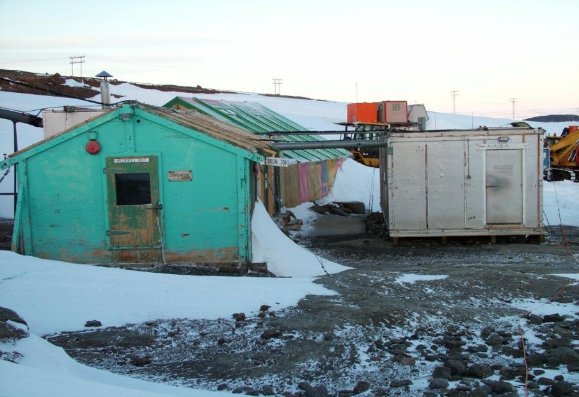
Electricians’ Workshop
The Electricians’ workshop is a 1954-built 7.3 m x 3.6 m aluminium panelled, flat-roofed PTB Mark III building constructed on railway sleepers on bedrock. The building has several small rooms: a cold porch, office, workshop and store. The building’s internal fixtures include wooden platforms along two walls, and metal brackets for internal support. Its triple-glazed perspex windows have been blocked up.
The Electrician’s Workshop has been used or known as the works hut, radio office and post office.
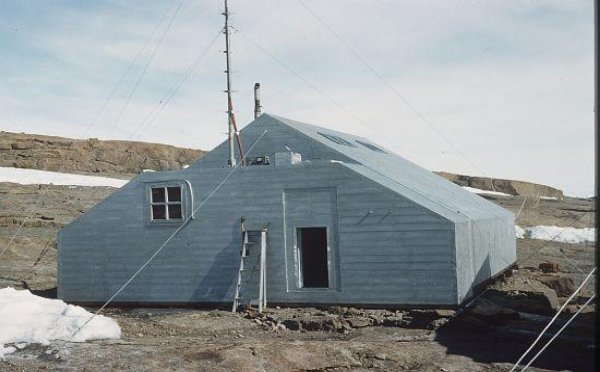
Biscoe (Old Living Quarters)
Biscoe is a 7.9 m x 7.9 m pitched-roof hut made by the Norsk Polar Institute and shipped to the station in 1954. It is made of pre-cut timber, sheeted with external timber boards and lined with masonite. It was later connected to Weddell by a 5 m annex.
Biscoe has also been used or known as the drying room, brewery, workshop, store, dog hospital, sewing room, laundry and carpenter’s shop.
Weddell (Old Carpenter’s Workshop – ‘Chippies’)
Weddell is a 7.3 m x 3.6 m pitched-roof PTB Mark I building originally erected on Heard Island in 1950. It has four windows and has built in work benches still remaining. It was shipped to Mawson in 1955 for use as sleeping quarters. It sits on sleeper and bedrock foundations and is made of plywood-skinned panels attached to a pre-cut timber frame. The annex joining it to Biscoe contained a laundry and an alcove in which timber was stored on racks. For many years husky pups were born and housed there.
Weddell has also been known or used as a sleeping hut, recreation hut (from 1961) and hobby shop (from 1984).
Old Surgery
The Old Surgery is a 1964 PTB building measuring 11.8 m x 4 m. The foundations comprise scaffold set into bedrock. It is clad with zincanneal panels. The fitting out of the interior was completed in 1965 and the building extended in 1969.
It is currently heated and used as an overflow plumber’s workshop and contains equipment for cutting sheet metal.
Magnetic Absolute Hut
The Magnetic Absolute Hut is a pitched-roof PTB Mark II building, 3.9 m x 3.6 m. It was erected on Heard Island in 1952 and re-erected at Mawson station in 1955. The hut is clad in onazote-insulated plywood-skinned panels, rests on sleepers, and is guyed to bedrock. The hut has seven large rectangular windows and four skylights. Its internal fixtures include a wooden pier to support magnetometers and other instruments. All the building’s fittings are non‑magnetic (e.g. brass door handles).
Electrical Store
The Electrical Store is a 7.3 m x 3.6 m plywood PTB Mark III building with a pitched-roof. It was constructed in 1954 and is the only remaining of a row of five huts originally running from the Radio Hut to the sea. The foundations comprise a stone base and timber sleepers. The building is painted yellow and orange.
The Electrical Store has also been known or used as Stores Hut #1 and the medical store.
Dovers (Old Sleeping Quarters)
Dovers is 9.7 m x 5.4 m and was erected in 1969 in the final form of the PTB Mark III style. It has pipe-scaffold foundations and is zincanneal steel clad. Dovers has five sleeping cubicles, ablutions and the ‘OICery’ (OIC’s bedroom and office).
Wilkins (Old Sleeping Quarters)
Wilkins is an 8.2 m x 4.5 m PTB Mark IV building erected in 1957. Wilkins is flat-roofed, insulated aluminium clad, and set on a wooden frame. The building has several rooms and fixtures: a cold porch, corridor and shower recess, and six dongas with beds, wardrobes and expeditioner-made furniture. The buildings foundations comprise a stone base and timber sleepers.
Shackleton (Old Sleeping Quarters)
Shackleton is an 8.2 m x 4.5 m PTB Mark IV flat-roofed building of insulated aluminium clad panels attached to a wooden frame. It was erected in 1957 and is ratcheted to wooden joists on railway sleeper stacks, and guyed from the roof and one joist. The building was used for accommodation and internally contains a cold porch, corridor and five dongas with beds, wardrobes and other fittings, and a lounge.
Dog Platform and Hut
The Dog Platform was built in 1976 and is made up of a wooden platform on wooden joists set on a galvanised scaffold drilled into bedrock. A ‘PID’ field hut and an asbestos cement panel dog hut were later added. The hut housed glaciology monitoring equipment at West Bay. When positioned on the platform it stored dog meat and equipment.
The following early structures are spread throughout the wider station area.
Hangar
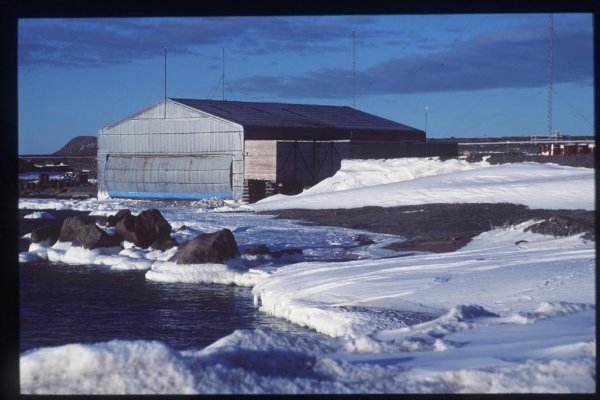
The Hangar is a 19.5 m x 19.5 m prefabricated building provided in 1956 to store RAAF planes. It is built directly on bedrock with an open web joist steel frame clad with corrugated and galvanised steel, and a full width vertical folding door. It has eight spaces and is partially floored with wooden packing cases stamped ‘RAAF Antarctica, DAK’.
The Hangar has also been used as a geophysics building and plumbers’ storage/workshop. The door has not been opened for some 10 years.
Cosray (Cosmic Ray Laboratory)
Cosray is a 16.4 m x 7.3 m PTB Mark III pitched-roof construction built from zincanneal panels with double-thick (6”) insulation, and set upon pipe-scaffold foundations. It was finished in 1972 and designed to house Geiger counters recording cosmic rays. A unique feature of this building is an 11 m shaft to a seismic vault and an underground observatory area lined with timber from a demolished riometer aerial.
Cosray housed Geiger counters until they were replaced in 1982 with proportional counter telescopes to record cosmic rays.
Wombat (Science Building)
Wombat is 9.4 m x 9.4 m and was erected in 1976. It has five rooms/workshops, a corridor and cold porch. It was an experiment using Hardiflex asbestos-clad insulated panel with insulated scaffold tube stumps and a rectangular hollow section steel framed insulated panel. Wombat has a pitched roof and is bolted via steel girders to galvanised steep scaffold pipes set into bedrock. The exterior is coated in yellow/brown resin and the building is accessed via metal steps and platforms.
Transmitter Building
The Transmitter Building is an asbestos-clad 9.4 m x 7.3 m structure erected in 1976 in the same style as Wombat. The building has a workshop and a room that houses banks of high frequency radio transmitters. The foundations are made of steel scaffolding.
Old Auroral Observatory [identified as ‘Hydroponics’ on current maps]
The Old Auroral Observatory is a 7.6 m x 3 m flat-roofed zincanneal clad panel building bolted to wooden joists placed on railway sleepers set on a stone base. It has a cold porch, workshop and office.
The Observatory originally housed a spectrophotometer. It is now used for hydroponics.
Graves and cairns
Three graves are located on West Arm. The graves are rock-covered coffins with brass plaques and white wooden crosses. Two of the graves have two plaques – one from the family of the deceased, and the other from Australian National Antarctic Research Expedition (ANARE) personnel. The graves are those of Robert White (d. 1963), Kenneth Wilson (d. 1972) and Geoffrey Cameron (d. 1974).
Alongside the graves is a fourth more recently built cairn containing the ashes of Phillip Law (d. 2010) and Nel Law (d. 1990) which were interned in 2011.
Building types (adapted from Rando 1996) | Examples |
PTB Mark I (plywood panels on sleepers and bedrock foundations—transferred from Heard Island and associated with the foundation of the station) | Weddell |
PTB Mark II (pitched-roof, insulated plywood panels, on sleepers and guyed to bedrock—transferred from Heard Island and associated with the foundation of the station) | Magnetic Absolute Hut |
PTB Mark III (aluminium panelled, flat roofed buildings built on railway sleepers and bedrock—erected in Mawson’s first year) | Electricians’ Workshop |
PTB Mark IV (flat-roofed insulated aluminium-clad panelled structures on a wooden frame—erected in 1957 and associated with the growth of the station) | Wilkins |
Gimesey (asbestos-clad insulated panels— precursors to the redevelopment of the station) | Wombat |
Table 1. Summary of significant pre-AANBUS building types.
2.4 Current uses
Mawson has supported research in the fields of cosmic ray physics, space physics, atmospheric physics, geophysics, glaciology, ecology of seabirds and marine mammals, meteorology and polar medicine. It remains the western-most focal point for Australian Antarctic science.
Two long-running investigations of populations and demographics of penguins are supported out of Mawson. An emperor penguin colony at Taylor Glacier has been studied intermittently from 1959 to 1987 and continuously since 1988. An Adélie penguin colony at Bèchervaise Island has been systematically studied since 1987 – the program informing the important work of the Commission for the Conservation of Antarctic Marine Living Resources.
Cosmic ray data collected at Mawson date back to 1955 and represent one of the longest standing scientific endeavours of the modern Australian Antarctic program. Underground and surface cosmic ray telescopes provide information on the influence of the interplanetary and geomagnetic fields on the propagation of galactic and solar cosmic rays, as well as the occurrence of large solar events that potentially pose a radiation hazard to aviation and space operations.
Several instruments related to space physics research and monitoring are also operated at Mawson. A sophisticated imaging Fabry-Perot spectrometer measures temperatures and vector winds in the lower thermosphere for investigation of small-scale processes in this region of the Earth’s environment. Continuous automated measurements of geomagnetic variations and ionospheric opacity and structure are used in various operation and research activities related to the near-Earth space environment.
Meteorological measurements made at Mawson provide one of the longest continuous records of weather and climate in East Antarctica. In addition to daily surface and upper air sounds, air samples are periodically obtained for trace gas analysis. Furthermore, an underground seismometer and a radionuclide atmospheric sampler contribute to monitoring associated with the Comprehensive Nuclear Test Ban Treaty.
All the buildings that are in use are maintained in accordance with an AAD seasonal maintenance and capital works program. Buildings found to be inappropriate for one reason or another have been extended, relocated or undergone significant renovation or modification in order to meet new demands such as the housing of new equipment. The relocation of operational activities to new buildings has also prompted the movement of some buildings to more convenient locations. Despite such changes, the old station cluster presents, somewhat, as a small village battling the elements.
Just as the buildings and their fittings have not remained static, the heritage values of Mawson evolve; they are not aligned with a single point in time. It is not necessary or even desirable, therefore, to maintain or restore buildings to their original use but rather to manage them so that, where possible, they continue to be useful, working structures for future programs.
Prior to heritage assessments undertaken in the 1990s, the station had not been assessed as a place of cultural or heritage significance. A draft heritage plan (Rando 1996) proposed the retention of a nucleus of eighteen of the older station buildings. Specifically, the proposal sought to preserve: (a) examples of the key ANARE building types; (b) the hub of the old station; (c) the buildings relocated from Heard Island; and (d) something of the village atmosphere of the old station core. It optimistically envisaged that the old station could exist as a heritage precinct and uses would be found for all the retained buildings. The assessments and draft heritage plan formed the basis of listings on the Register of the National Estate listing in 2001, and the Commonwealth Heritage List in 2004.
Notwithstanding the station’s existence as a Commonwealth Heritage place for some years, few expeditioners and AAD head office staff have much knowledge of the station’s history beyond the significance of its name.

Figure 2. Mawson buildings and structures.
3. Assessment of Commonwealth Heritage values
Mawson’s heritage ‘significance’ forms the foundation upon which conservation policy for the place is developed. The EPBC Act (s.528) defines the ‘heritage value’ of a place as including the place’s natural and cultural environment having aesthetic, historic, scientific or social significance, or other significance, for current and future generations of Australians.
In 1992-93, the cultural significance of the thirteen station buildings that had been entered on to the Register of the National Estate was formally assessed by Elspeth Wishart and Linda Clarke from the Queen Victoria Museum and Art Gallery, Tasmania.
In 1996, Sam Rando and Martin Davies conducted a further assessment using the scale outlined in Kerr (1990). Their assessment established the presence of values consistent with Commonwealth Heritage listing.
Rando and Davies’ analysis, and the statements of significance associated with Mawson’s Register of National Estate listing, and Commonwealth Heritage listing in 2004 (Place ID 105444) – are provided at Appendix II. The latter forms the foundations for site management planning. In developing this plan, the values identified in the official listing were revisted in consultation with individuals with relevant expertise. The review process reaffirmed the validity of the Commonwealth Heritage values that were originally identified. The review conclusions are summarised at Table 2.
Criteria | Values |
A Processes | Mawson’s status as the oldest continuously occupied scientific station in Antarctica, the first permanent station south of the Antarctic circle, and Australia’s first continental station remains unchanged. |
B Rarity | Mawson’s buildings remain rare in that modern stations are entirely different in their scale, planning and construction. |
D Characteristic values | The buildings at Mawson continue to be a representation of the characteristics of early Antarctic stations and the way of life of early expeditions. |
E Aesthetic characteristics | The village arrangement of Mawson, backed by distant views of ice cap and mountain, remains a striking and unusual landscape evocative of ‘frontier living’. |
F Technical achievement | Mawson represents the most complete surviving collection of buildings demonstrating the evolution of Australian Antarctic building design. |
H Significant people | The establishment and early operations of the station remain closely associated with people significant in Australia's Antarctic history including Phillip Law, John Béchervaise and Robert Dovers. The Station was named by Law after Sir Douglas Mawson.
|
Table 2. Validation of the relevance of the Commonwealth eritage values identified in 2004.
4. Condition of Commonwealth Heritage values
There are two different methods of analysing the condition and integrity of heritage values:
- the condition of the significant heritage fabric; and
- the condition of the Commonwealth Heritage values themselves.
An assessment by each method is presented below.
The condition of the fabric has been evaluated using the terms below which are consistent with State of the Environment guidelines for assessing the condition of heritage places (see Pearson and Marshall 2006:31-32):
- Good: Structurally sound, weather tight, important features well maintained, no significant repair needed.
- Fair: Structurally sound, retains major features, needs minor repairs.
- Poor: Damaged, structurally unstable, erosion, disturbance, walls or floors missing or dilapidated.
Three levels of judgement have been used to indicate the ‘integrity’ of the value, or in other words the intactness of the fabric reflecting the value:
- High: Features largely intact, no significant removals, modifications or additions.
- Medium: Some important elements lost, retains enough significant fabric to be understood and interpreted.
- Low: Significant elements destroyed, removed, replaced, rearranged or altered.
4.1 Condition of significant heritage fabric
Mawson station buildings, like any in Antarctica, are subject to extreme weather conditions. They will, without a high degree of regular maintenance, deteriorate rapidly.
Maintenance of the early buildings has focussed on those still serving an operational role. Thus while obvious damage to vacated buildings has been repaired, work on these structures has been directed at maintaining them at a safe standard. The condition of many of the old station buildings in recent years has also been affected by the disconnection of site services.
External cladding
The external cladding of the early buildings is in various stages of disrepair and decay; some contain asbestos. Abrasion from wind, seasonal freezing and thawing has caused the external skin to delaminate, paint to flake, and tie rods to rust and corrode. These actions have resulted in a loss of external integrity of some PTB buildings.
The operational AANBUS buildings are subject to regular maintenance, and the integrity of their external cladding is high.
Internal spaces and fixtures
Many of the early buildings have been altered to accommodate new functions. The degree of internal modification varies from little or no internal alteration (e.g. Shackleton) to a comprehensive refit to accommodate a different purpose (e.g. Old Auroral Observatory). As noted by Rando (1996:80):
Very few of the old station buildings at Mawson remain entirely unaltered, with a complete set of original building components. Even a cursory glance through the annual station reports reveals the regularity with which individual building parts have been changed, replaced or rearranged. Internal building alterations associated with changes in use have often been dramatic. The partial or wholesale gutting and refitting of old station buildings to accommodate new uses has been a hallmark of Mawson buildings from the earliest years.
An assessment of the AANBUS buildings was completed in 2011; the condition and integrity of the buildings were deemed ‘Good’ and ‘High’. A summary of the condition and integrity of the site’s fabric is provided at Table 3.
4.2 Condition of Commonwealth Heritage values
Table 4 summarises the condition of Commonwealth Heritage values.
Fabric and values assessed, | Condition | Integrity |
Electricians’ Workshop | Poor | High |
Biscoe | Fair | Exterior medium: Wholesale changes. |
Weddell | Poor but weatherproof | Exterior medium. |
Magnetic Absolute Hut | Fair: The building remains fully functional and essentially weatherproof | Exterior high: Only old station building in original external condition. |
Cemetery (3 graves) | Fair | High |
Electrical Store | Poor | Exterior high: Minor external repair and maintenance. |
Hangar | Fair | High |
Wilkins | Fair: Structurally sound, the floor panels are in poor condition. | Exterior medium: Minor external repair and maintenance. |
Shackleton | Poor | Exterior low. |
Dovers | Fair | Exterior medium: Minor external repair and maintenance. |
Cosray | Good | Medium: Renovated in the 1980s and an addition made to the building. |
Wombat | Fair: Building remains functional | Exterior medium: Minor external repair and maintenance. |
Transmitter Building | Fair: Remains structurally sound and weather tight | Exterior medium: Minor external repair. |
Dog Platform and Hut | Fair | High |
Old Auroral Observatory
| Fair: Structurally sound and well maintained | Low: The only remaining feature connected with the original use is the dome at the SW corner of the roof. |
Table 3. Condition and integrity of the fabric of early Mawson buildings and structures.
Value | Attributes | Condition | Integrity |
Processes | The fabric and site layout that dates from the station establishment phase to contemporary times.
| Fair | Low: 3 of the 5 1954 buildings survive, but only 8 of the 30 1954-57 buildings remain.
|
Rarity | Station design and simple communal lifestyle demonstrated in the buildings and landscape. | Poor
| Medium: Some buildings evoke previous lifestyle although removal has lessened feel. |
Research | Some of the buildings that were constructed specifically for scientific observations and may be both used again for scientific observations and offer an insight into the development of Antarctic science. | Fair
| High: Several remain serviceable, in use and retain their original functions. |
Characteristics | Sites that reflect the characteristics of assertions of sovereignty.
| Good
| High
|
The station building collection, a remnant of its former village-like layout, is an intact representation of the characteristics of Antarctic stations and the way of life of expeditioners in the early years of Australia’s permanent involvement on the continent. | Poor | Low: Village-like arrangement now difficult to discern, as only 6 buildings of that core remain. | |
Aesthetic characteristics | The village-like arrangement of the old buildings, backed by the newer station and the distant views of ice cap and mountains. | Fair | High: Old buildings overwhelmed by new station. |
Technical achievement | The most complete surviving collection of buildings demonstrating the evolution of Australian Antarctic building design and innovation to deal with polar conditions. | Good: Has examples of all PTB Marks I to IV and the Gimesey type. | Medium
|
|
|
|
|
|
|
| |
Significant people | Association with Douglas Mawson, founder of Australia’s Antarctic endeavours. | Fair: Little likely understood | Medium
|
For decisions reflected in design and layout: Phillip Law, John Béchervaise, and Robert Dovers. | Fair: Associations persist, but are largely swamped by the new station. | Low |
Table 4. Condition of Commonwealth Heritage values.
5. Management framework
5.1 Site governance
Responsibility for the Mawson station site is vested in the AAD of the Department of the Environment on behalf of the Australian Government. This responsibility includes ensuring that the heritage values of the site are preserved and that these values are interpreted and presented to the Australian community.
The Australian Heritage Council advises the Minister on identification, assessment, conservation and monitoring of heritage, and in particular provides comment to the Minister on plans of management for listed sites.
Furthermore, three key pieces of Australian legislation apply to the management of Mawson’s heritage values – the EPBC Act, the Antarctic Treaty (Environment Protection) Act 1980 (ATEP Act) and the Protection of Movable Cultural Heritage Act 1986.
5.2 Environment Protection and Biodiversity Conservation Act 1999
Mawson is listed on the Commonwealth Heritage List under the EPBC Act. This Act requires the responsible government agency to make a plan to protect and manage the Commonwealth Heritage values of places that it owns or controls. Plans are binding on the Commonwealth and Commonwealth agencies.
The EPBC Act requires an action on Commonwealth land which is likely to have a significant impact on the environment, or an action taken elsewhere that is likely to have a significant impact on the environment on Commonwealth land, to be ‘referred’ for approval under the Act. Mawson is on Commonwealth land, and ‘Environment’ is defined in the Act to include ‘the heritage values of places’.
The Minister, or his delegate, is responsible for the provision of advice on and approval of on-site activities under the EPBC Act.
5.3 Antarctic Treaty (Environmental Protection) Act 1980
Australia, as a party to the Antarctic Treaty (1959) and the Protocol on Environmental Protection to the Antarctic Treaty (Madrid Protocol, 1991), is bound by these instruments’ provisions on cultural and natural heritage. They are given effect, for Australia, by the ATEP Act.
The ATEP Act requires that Australian activities in the Antarctic undergo prior environmental impact assessment. If the Minister (or delegate) considers that the environmental impact is likely to be no more than minor or transitory, the Minister may grant the proponent a written authorisation to carry on the activity. The Minister may choose to impose conditions to protect the environment and take into account other relevant considerations. More detailed assessments (initial environmental evaluations or comprehensive environmental evaluations) are required for activities likely to involve higher levels of impact.
The Minister, or his delegate, is responsible for the provision of advice on and approval of on-site activities under the ATEP Act.
5.4 Protection of Movable Cultural Heritage Act 1986
The Protection of Movable Cultural Heritage Act regulates the export of Australia's significant cultural heritage objects. This Act therefore may cover artefacts that are at or are associated with the Mawson site.
6. Management goals and constraints
6.1 Goals
It is desirable that Mawson’s early buildings play an important role in the operational life of the contemporary station; the AAD aims to ensure that on-site conservation, continued use, documentation and heritage interpretation programs are established. Management of Mawson’s heritage values should also complement the operational objectives of the AAD in delivering the goals of the Australian Antarctic program.
The provisions in this management plan seek to provide for the protection of the station’s Commonwealth and other heritage values while providing for the ongoing support of science in Antarctica – within the context of Mawson’s remoteness, and the environmental, financial, operational and logistic constraints that arise.
Just as many of the buildings and their fittings have changed, the heritage values of Mawson are not from a single point in time. Values are embodied in the evolution of the buildings from use to use. It is not necessary, therefore, to maintain or restore buildings to their original use but rather, to manage them so that they continue to be useful, working structures for future programs. This plan provides for such adaptations to continue.
The AAD intends to, wherever possible include the early buildings in the active life of the station; continued use or adaptive re-use is preferable to removal. The re-use and adaptation of buildings is in line with past practices whereby individual buildings have, as required, been relocated, refitted or extended as expeditioner numbers, science programs and the like have dictated the need. Where it is not practical to continue to use buildings, the buildings will need to be removed and actions undertaken to conserve their heritage values through interpretation.
Table 5 summarises the envisaged future of the fabric of Mawson’s early station buildings and structures.
6.2 Pressures on Commonwealth Heritage values
Planning and programs to conserve Commonwealth Heritage values involving the retention of building fabric in situ can be constrained by a range of environmental, logistical and administrative pressures, including those identified below. The building futures outlined at Table5 reflect the predicted influence of such factors.
Logistical constraints
Mawson is some 5000 km from many of the services typically available to other Australian communities. The remoteness of Mawson – the furthest Australian Antarctic facility from Hobart port – is only mitigated to a minimal degree by year-round occupancy and a relatively safe anchorage in summer.
Building | Proposed future (by 2019) | Proposed future (by 2024) |
Electrician’s Workshop | Demolition (assuming no use identified) |
|
Biscoe | Conservation for use as a music room | Use as a music room |
Weddell | Conservation for use as a hobby hut | Use as a hobby hut |
Old Surgery | Ongoing use as sheet metal (plumber’s) workshop | Ongoing use as sheet metal (plumber’s) workshop |
Magnetic Absolute Hut | Ongoing use as research facility | Ongoing use as a research facility |
Electrician’s Store | Demolition (assuming no use identified) |
|
Dovers | Demolition (assuming no use identified) |
|
Wilkins | Demolition (assuming no use identified) |
|
Shackleton | Basic maintenance | Retention and refurbishment as old-style accommodation without facilities (should demand exist and workplace health and safety allow) |
Dog Hut and Platform | Demolition (likely unmanageable asbestos hazards) |
|
Hangar | Basic maintenance | Materials and/or vehicle storage |
Cosmic Ray Observatory | Ongoing use as a research facility | Ongoing use as a research facility |
Wombat (‘Science’) | Demolition (unsuited to refurbishment; asbestos hazard) |
|
Transmitter Building | Demolition (assuming no use identified; asbestos hazard) |
|
Old Auroral Observatory | Ongoing use as a hydroponics facility | Ongoing use as a hydroponics facility |
Table 5. Forecast future of early station buildings and structures.
Funding constraints
The AAD as the agency responsible for the site needs to balance the needs of supporting and conducting science with its obligations to preserve the heritage values of the station (coupled with the demands of other sites including Mawson’s Australasian Antarctic Expedition (1911-14) huts at Commonwealth Bay).
The AAD is not specifically funded to undertake heritage conservation activities yet the repair and conservation of buildings at Mawson will likely involve employing heritage specialists; the installation of heating and fire protection systems; and increased power generation to provide hot water and heating – amounting, potentially, to hundreds of thousands of dollars per year. (When the ancillary costs of supporting a person in Antarctica are factored, the cost of one trade hour is in the order of $200/hour.)
Environmental factors
Winds at Mawson can gust between 25 to 50 m/sec and cause abrasion from wind-driven snow and ice (‘corrosion’), presenting a significant threat to wooden structures.
Strong wind can also delay work on buildings for days through to an entire summer season and as a result of exposure to wind chill it can make work physically difficult for expeditioners. The harsh wind conditions were acknowledged by early expeditioners and as a result processes and techniques were developed to allow for rapid assembly of prefabricated panels.
The winds drive snow drift up and into buildings. Minute particles can penetrate weaknesses in the skin of buildings gradually freezing the walls and interior. Freezing and thawing processes have significant impacts – de-lamination of the skins of buildings, and internal damage to paintwork and fittings. Ice build-up underneath buildings can also cause floors to warp and lift.
Over the winter months, access to many buildings in the village precinct is blocked by snow drift – presenting a challenge for their continued year-round use.
The dry environment also creates fire risks. Timber buildings are especially vulnerable.
Inadvertent damage or impacts
Emergency interventions; actions to move snow or divert melt water to prevent accumulation under and around buildings; maintenance to address structural deficiencies; and conservation works needed to, for example, reconstruct fittings broken by ice loads, may pose risks to other fabric or the visual integrity of the site.
Risks to cultural heritage objects
Conservation work and the removal of snow and ice from the buildings and structures may also displace cultural heritage objects from their context.
The AAD is not a collections institute and does not have the capacity or resources to properly manage artefacts on a large scale.
Compliance with contemporary building standards
The modifications needed to facilitate the compliance of early buildings with contemporary building standards may have significant and unavoidable adverse impacts on one or more of the buildings’ Commonwealth Heritage values.
Some unavoidable actions, for example the removal of interior and exterior asbestos cement sheeting, may compromise the conservation of heritage values and serve only to prolong the obligation to maintain buildings that are better removed because they are no longer fit for purpose and cannot be made fit for other purposes.
Legislated obligations to clean-up sites of past activity
Australian legislation implementing the Madrid Protocol – the Antarctic Treaty (Environment Protection) (Waste Management) Regulations 1994 – includes a requirement to clean up sites of past activity.
7. Management policies
Management policies will uphold the conservation philosophy of this plan, as well as address legislative obligations.
Policy (1) Site management will uphold key conservation principles
(A) Conservation should be undertaken in accordance with accepted guidelines
Work on station buildings with heritage values is to be undertaken with reference to the principles and guidelines of the Burra Charter, the Australia ICOMOS Charter for the Conservation of Places of Cultural Significance and other relevant guidelines.
(B) Decisions should be based on an understanding of the Burra Charter, cultural significance and scientific practice
All management decisions with the potential to affect the heritage values of the place, must be founded on a clear understanding of those values. The heritage impact of decisions should be stated and evaluated as part of the decision-making process. The impact of particular actions should be determined based on the analysis of relevant data.
(C) A cautious approach is required where actions may have adverse heritage impacts
Where management actions or decisions may result in a loss of cultural significance, these actions should only be pursued if there are no alternatives which avoid impacts, and the actions are reversible or, at the very least, involve the minimum amount of change possible.
(D) Heritage structures should be stabilised
Structures retained on station will be stabilised and managed in order to limit further physical deterioration.
The stabilisation and weatherproofing of structures that assessments have determined are under threat should receive highest priority for protective and remedial works.
(E) Heritage structures and items should be kept in situ
Mawson station heritage combines historic fabric, a distinctive visual presence, and a remote and evocative landscape. These three elements — fabric, design and setting — will be conserved in situ where possible.
(F) The Mawson station story should be told
See Policy 16.
Policy (2) Site management will work towards long-term goals consistent with the conservation philosophy
Long-term goals for site management should be consistent with the conservation philosophy articulated at the beginning of this plan. While the overall goal for the site is to conserve, interpret and transmit its heritage values, this will be best achieved by conserving individual elements in different ways. This may see buildings, in a triage style process, adaptively reused, actively or otherwise maintained, or documented and removed because it is not prudent and feasible to maintain them.
Policy (3) Site management will comply with Antarctic Treaty requirements and Australian law
The Commonwealth Heritage values of the site will be conserved in accordance with the EPBC Act and the Burra Charter: the Australia ICOMOS Charter for Places of Cultural Significance.
Management of the site will also comply with the requirements of the Protocol on Environmental Protection to the Antarctic Treaty, and the ATEP Act.
Policy (4) Intervention and conservation processes will be sympathetic to heritage values
The repair of original fabric will be progressed in preference to replacement with new material. Missing fabric may be reconstructed if such action is required to protect significant elements or for operational requirements. No conjectural reconstructions of missing elements will occur.
Intervention in the external fabric of buildings should be minimal. Where possible, materials used to replace or repair external building components should be similar in form, material and appearance to the existing fabric. The visual impact of new materials should be assessed prior to their introduction to ensure that they do not dominate the existing historic fabric.
Although the preferred option is that building interiors will not be altered, adaptations required to accommodate new and compatible uses will be permissible.
Policy (5) Only appropriate development and adaptive reuse will occur
In keeping with the spirit of change of building use, buildings may be developed and reused. Any reuse or development should avoid significant degradation or disturbance of heritage values.
Policy (6) Heritage impact assessments will be undertaken
Heritage impact assessments will be undertaken prior to works beyond routine maintenance or urgent stabilisation or actions not anticipated at Table 5.
Policy (7) Environmental impacts will be avoided or minimised
Conservation and management actions will have regard to their broader environmental impact and will be planned to avoid adverse impact to either the built or natural environment. If adverse impacts are unavoidable, they are to be minimised.
Policy (8) Cultural heritage objects will be registered and conserved
Cultural heritage objects will be registered on a publicly accessible database.
If objects are removed from the station, as may be required to provide for development, reuse or divestment, they will be fully documented prior to their removal. To preserve the archaeological (as opposed to interpretive or aesthetic) value of these objects, their location should be documented before they are moved.
Significant objects will be treated to stall further deterioration. Representative items may be removed for reference in Australia, for future research, and to inform conservation work programs.
Policy (9) Controlled public access will be permitted
Building access by tourists and other visitors not engaged in inspections under the Antarctic Treaty will be permitted at the discretion of the AAD. Any decision to allow tourists into buildings should not lead to degradation of the condition and integrity of the heritage values of the place.
Policy (10) Stakeholders will be encouraged to contribute
The participation of stakeholders is essential to ensuring commitment and cooperation in the conservation of Antarctic heritage. Key stakeholders will be consulted on any changes to the management direction proposed in this plan. Stakeholders include former expeditioners and the ANARE Club; international polar organisations and forums including the International Polar Heritage Scientific Committee of ICOMOS; and Australian heritage organisations and collections agencies.
Policy (11) Discoveries are to be reported
Decisions on the management of unforseen discoveries or disturbance of heritage will be based upon an understanding of cultural significance and scientific practice. Discoveries of pre-1958 remains will also be provided interim protection in accordance with Resolution 5 of the 2001 Antarctic Treaty Consultative Meeting (see Appendix III).
Policy (12) Appropriate expertise will be sourced
All management decisions which have the potential to significantly affect the Commonwealth Heritage values of the site will be founded on advice obtained through consultation with qualified professionals or by employing specialist technical expertise. The particular expertise needed will be dictated by the issue to be managed.
Construction works will be carried out by licensed and appropriately specialised tradespersons, and the AAD will ensure that all contractors and consultants working on heritage fabric are aware of the management plan for the site and have been educated as to the site’s heritage values.
The management of asbestos containing material will be undertaken in accordance with the relevant AAD asbestos register and the AAD’s asbestos management plan. (Asbestos has been identified in a number of the old buildings and structures. Activities that have the potential to disturb this material must be managed to prevent fibres from becoming airborne and creating an inhalation hazard.)
Policy (13) Recording should precede and follow conservation works
Records will be maintained of the management of the station’s heritage fabric. Archival recording will be carried out prior to and on completion of any conservation work.
Archival recording should include references to measured drawings of buildings and structures; photographic recording; and ‘as-built’ records of buildings and structures indicating the location and detail of changes.
Policy (14) Monitoring should be targeted and regular
Changes in the physical condition of buildings will be monitored to evaluate the effectiveness of the management plan. The results of the monitoring program will inform the development of annual maintenance schedules and budgets.
Policy (15) Heritage research may be permitted
Requests to undertake research will be considered and prioritised alongside other projects demanding significant resources. The associated data and reports will be lodged with the Australian Antarctic Data Centre and the AAD library.
Policy (16) Interpretive material will be prepared
Tools and or training will enhance expeditioners’ appreciation of and respect for the site’s historic fabric and heritage values.
Web-focussed interpretative materials will be developed to promote a richer understanding of the site and to make related management decision making more accessible to the broader community.
Artefacts may be made available for exhibition.
8. Implementation plan
The following actions will be given effect by the Director of the AAD within the ten years following formal adoption of the plan.
8.1 Fabric conservation and building adaptation or demolition works
Phase | Action |
Routine maintenance | Annual repairs and maintenance to, as a minimum, reduce or prevent snow and melt water ingress and ice accumulation |
Restoration of broken internal fittings | Repair of internal fittings damaged by melt water and ice |
Refurbishment / adaptation | Modifications as necessary to accommodate alternate uses |
Authorisation | Assess in accordance with the AT(EP) Act, and refer significant proposed actions for approval in accordance with EPBC Act requirements |
Demolition and site remediation | Demolition, if approved, and return to Australia of redundant buildings as resources permit (refer Table 5); remediation of site within 2 years of building removal |
8.2 Objects and collections management
Phase | Action |
Documentation | Document cultural heritage objects on the AAD Antarctic Heritage Register |
Assessment and conservation | Conserve significant cultural heritage objects and present them in situ where possible |
Collection management | Manage objects returned to Australia in a manner consistent with AAD policies |
8.3 Interpretation
Phase | Action |
Resource development | Prepare interpretative material appropriate to the interests of expeditioners, other site visitors and the broader public |
On-site signage | Install any signage needed to assist in the presentation of Mawson’s Commonwealth Heritage values |
8.4 Research and assessment
Phase | Action |
Planning | Develop and/or review proposals to undertake heritage research at the station |
Work on site | Facilitate the conduct of priority heritage research |
Review
| Review values assessments and statements of significance in light of changes to the site |
8.5 Records management
Phase | Action |
Archival recording | Retain original documentation and undertake archival recording prior to and on completion of conservation or demolition works on the site |
Information management system | Ensure records from works programs are appropriately maintained |
Cataloguing and archiving | Catalogue and archive data sets (architectural drawings, building reports and photographic records) held by the AAD |
8.6 Monitoring and review of the plan
Phase | Action |
Routine monitoring and reporting | Include in annual station leader reports, details of checks, maintenance and conservation or demolition works undertaken |
Condition assessments | Update condition reports on significant fabric, using previous reports as a baseline |
Review | At least once every five years, review the management plan and its effectiveness and identify new or changed information from monitoring, community input and/or further research which may indicate changes required to the management plan |
References
Australia ICOMOS (1999). The Burra Charter (The Australia ICOMOS Charter for places of cultural significance). www.icomos.org/australia/burra.html.
Australian Heritage Commission (2001). Australian historic themes: a framework for use in heritage assessment and management. www.ahc.gov.au/publications/generalpubs/framework/pubs/
themes.pdf.
Clark, L. and Wishart, E. (1993). Mawson Feature Index. Queen Victoria Museum and Art Gallery.
Department of the Environment and Heritage (2005). Heritage Strategy: a strategy for managing places owned or controlled by the Department to protect and conserve their Commonwealth Heritage values. www.environment.gov.au/heritage/publications/strategy/pubs/deh-heritage-strategy.pdf.
Department of the Environment and Heritage (2006). Management Plans for Places on the Commonwealth Heritage List: A guide for Commonwealth agencies. www.environment.gov.au/heritage/publications/management-plans/pubs/management-plans.pdf.
Kerr, J. (1990). The conservation plan: A guide to the preparation of conservation plans for places of European cultural significance. National Trust of Australia.
Marquis-Kyle, P. and Walker, M. (2004). The Illustrated Burra Charter: Good Practice for Heritage Places.
Pike, R. and Crossman, A. (1994). Mawson Old Station Information. Unpublished document prepared for the Australian Antarctic Division.
Productivity Commission (2006). Conservation of Australia’s Historic Heritage Places. www.pc.gov.au/inquiry/heritage/docs/finalreport.
Rando, S. (1996). Mawson Station Heritage Plan. Unpublished document prepared for the Australian Antarctic Division.
Rando, S. and Davies, M. (1996). Mawson Station Supplementary Heritage Study. Unpublished document prepared for the Australian Antarctic Division.
Appendix I. Building images
Electricians’ Workshop

(Paul Munro, 1992)
(Doug McVeigh, 2004) – the Electricians’ Workshop is the grey building
Biscoe
 (Phillip Law, 1954)

(Nisha Harris, 2011)
Weddell Hut

(Kevin Felton, 1961) – Weddell Hut is the building with the red roof

(Robert Jones, 1997)
Old Surgery

(Sandra Potter, 2012)
Wilkins 
(Robert Jones, 2013)
Magnetic Absolute Hut

(Phillip Law, 1955) – the Magnetic Absolute Hut is on the far right

(Sandra Potter, 2012)
Electrical Store
(Phillip Law, 1961)

Dovers
 (Mike Staples, 1996)
(Robert Jones, 2013)
Shackleton

(Phillip Law, 1966)

(Robert Jones, 2013)
Dog Platform  (Robert Cechet, 1983)
 (Sandra Potter, 2012)
Hangar

(Dave McCormack, 1997)
Cosray

(Unknown, 1983)
 (Sandra Potter, 2012)
Wombat (Rex Moncur, 1987)
 (Sandra Potter, 2012)
Transmitter Building
(Alan Campbell-Drury, 1964) – view of radio racks

(Alan Wilkinson, 1988)
Old Auroral Hut

(Phillip Law, 1963) – taken during extensions
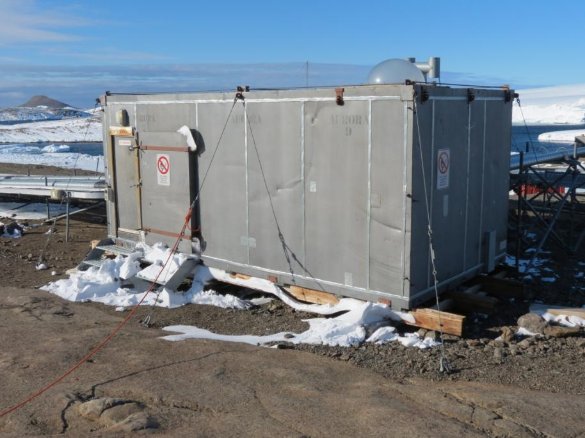
(Sandra Potter, 2012)
AANBUS-style buildings
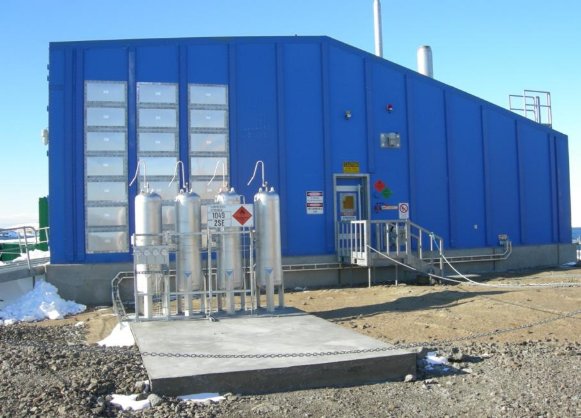

(Sandra Potter, 2012)
Appendix II. Statements of significance
Commonwealth Heritage List (2004)
Mawson Station, established in 1954, is the oldest continuously occupied scientific station in Antarctica and the first permanent station south of the Antarctic Circle. It was Australia's first continental station, reflecting the post-World War Two revival of Australia's scientific research and territorial interests in Antarctica (Criterion A.4).
The establishment and early operations of the station were closely associated with several people of significance in Australia's Antarctic history, whose associations are reflected in planning and design decisions preserved in the surviving buildings. These include Phillip Law, John Béchervaise and Robert Dovers. The Station was named by Law after Sir Douglas Mawson (Criterion H.1).
Mawson Station retains the most complete surviving collection of buildings demonstrating the evolution of Antarctic building design used by Australian National Antarctic Research Expeditions (ANARE). These buildings demonstrate experimentation with different construction methods, cladding materials and foundation systems and innovation to deal with polar conditions. These designs are now entirely superseded by the modern Australian Antarctic Building System (AANBUS) modular system (Criterion F.1).
The Mawson Station building collection, a remnant of its former village layout, is an intact representation of the characteristics of Antarctic stations and the way of life of expeditioners, as they existed for the first forty years of Australia's permanent involvement on the continent (Criterion D.2).
The modern stations are entirely different in their scale, planning and construction and the lifestyle of expeditioners has changed dramatically. The original station design and lifestyle are no longer practiced and the demonstration of them to the degree seen in the Mawson buildings and landscape is now very rare (Criterion B.2).
The village arrangement of Mawson Station's old buildings backed by the newer station and the more distant views of ice cap and mountains is highly regarded as a striking and unusual landscape (Criterion E.1).
Criteria | Values |
A Processes | Mawson Station, established in 1954, is the oldest continuously occupied scientific station in Antarctica and the first permanent station south of the Antarctic Circle. It was Australia's first continental station, reflecting the post-World War Two revival of Australia's scientific research and territorial interests in Antarctica. Attributes: The whole of the station, but particularly fabric and site layout that dates from the earlier establishment phase. |
B Rarity | The modern stations are entirely different in their scale, planning and construction and the lifestyle of expeditioners has changed dramatically. The original station design and lifestyle are no longer practiced and the demonstration of them to the degree seen in the Mawson buildings and landscape is now very rare. Attributes: The original station design evidenced in the scale, planning and construction of the facility. |
D Characteristic values | The Mawson Station building collection, a remnant of its former village layout, is an intact representation of the characteristics of Antarctic stations and the way of life of expeditioners, as they existed for the first forty years of Australia's permanent involvement on the continent. Attributes: The Mawson Station building collection as a remnant of its former village layout. |
E Aesthetic characteristics | The village arrangement of Mawson Station's old buildings backed by the newer station and the more distant views of ice cap and mountains is highly regarded as a striking and unusual landscape. Attributes: The whole of the station, in particular the planning, layout and design of the buildings and their setting in the polar landscape. |
F Technical achievement | Mawson Station retains the most complete surviving collection of buildings demonstrating the evolution of Antarctic building design used by Australian National Antarctic Research Expeditions (ANARE). These buildings demonstrate experimentation with different construction methods, cladding materials and foundation systems and innovation to deal with polar conditions. These designs are now entirely superseded by the modern Australian Antarctic Building System (AANBUS) modular system. Attributes: The surviving collection of buildings used by ANARE. |
H Significant people | The establishment and early operations of the station were closely associated with several people of significance in Australia's Antarctic history, whose associations are reflected in planning and design decisions preserved in the surviving buildings. These include Phillip Law, John Béchervaise and Robert Dovers. The Station was named by Law after Sir Douglas Mawson. Attributes: The planning, layout and design of the buildings. |
Register of the National Estate (2001)
Mawson Station, established in 1954, is the oldest continuously occupied scientific station in Antarctica and the first permanent station south of the Antarctic Circle. It was Australia's first continental station, reflecting the post-World War Two revival of Australia's scientific research and territorial interests in Antarctica (Criterion A.4).
The establishment and early operations of the station were closely associated with several people of significance in Australia's Antarctic history, whose associations are reflected in planning and design decisions preserved in the surviving buildings. These include Phillip Law, John Béchervaise and Robert Dovers. The Station was named by Law after Sir Douglas Mawson (Criterion H.1).
Mawson Station retains the most complete surviving collection of buildings demonstrating the evolution of Antarctic building design used by Australian National Antarctic Research Expeditions (ANARE). These buildings demonstrate experimentation with different construction methods, cladding materials and foundation systems and innovation to deal with polar conditions. These designs are now entirely superseded by the modern Australian Antarctic Building System (AANBUS) modular system (Criterion F.1).
The Mawson Station building collection, a remnant of its former village layout, is an intact representation of the characteristics of Antarctic stations and the way of life of expeditioners, as they existed for the first forty years of Australia's permanent involvement on the continent (Criterion D.2).
The modern stations are entirely different in their scale, planning and construction and the lifestyle of expeditioners has changed dramatically. The original station design and lifestyle are no longer practiced and the demonstration of them to the degree seen in the Mawson buildings and landscape is now very rare (Criterion B.2).
The village arrangement of Mawson Station's old buildings backed by the newer station and the more distant views of ice cap and mountains is highly regarded as a striking and unusual landscape (Criterion E.1)
Mawson Station Heritage Plan statement of significance and overall assessment (1996)
Mawson is the oldest continuously occupied scientific station in Antarctica. It is the most picturesque of Australia's Antarctic stations with the new buildings towering over the older compact station that nestles close to the shores of the harbour. A distinctive streetscape has evolved amongst the starkly functional buildings of the old station which is held in high regard by the expeditioner community, as evidenced by the naming of streets and open areas within the "village".
Mawson is the only Australian station where all of the main building designs employed by ANARE are represented. As such, the station uniquely demonstrates the evolution of Australian Antarctic building designs and allows comparisons to be made between the relative success of particular designs and materials utilised. The buildings of the old station, individually and collectively, demonstrate the distinctive way of life that evolved at Australia's three Antarctic stations. They bear testimony to the endeavours of the many men and women who have contributed to Australia's prominent role in Antarctica. The cultural value of the site is enhanced by the existence of an assortment of vehicle remains and equipment dating back to the early years of operation and the presence on-station and in the hinterland of examples of most of the recognised traverse van and field refuge types utilised by ANARE.
The historic value of the place dates from the 13th February 1954, when Phillip Law raised the Australian flag and named the station in honour of Sir Douglas Mawson. This simple ceremony symbolises the commencement of a permanent Australian presence in Antarctica as it laid the foundation for the growth and evolution of Mawson station and the subsequent establishment and development of Davis and Casey stations. The three BANZARE proclamation sites are tangible evidence of Australia's participation in the race for territorial acquisitions which characterised Antarctic activities in the first half of the twentieth century.
As the first permanent Australian station on the Antarctic continent, Mawson laid the foundation for the development of Davis and Casey stations. Although each of the three early stations had distinctive characteristics, they all closely followed the style of Mawson. Many building designs were initially trialled at Mawson before being considered for use at other stations.
The distinctive (and essentially similar) way of life that evolved at Australia's original Antarctic stations is best demonstrated at Mawson and Davis where significant numbers of old station buildings remain. This lifestyle has changed significantly with the introduction of modern technology and improved communications which have accompanied the station rebuilding program.
Although the station as a whole has limited educational or research value, scope does exist to use individual buildings and objects to teach expeditioner populations about characteristic facets of early station life at Mawson. Appropriately displayed and interpreted artefacts associated with bygone features of the station, such as sledge dogs and early aviation, can act as powerful educational tools and be used to enhance expeditioner appreciation of ANARE heritage. The provision of directed historical information at individual station buildings and field refuges could be used to similar effect.
Mawson retains more completely than either Davis or Casey, many of the features that were common to Australia's continental stations prior to the commencement of the rebuilding program. The collection of old station building types present at Mawson typify the structures used at Australia's early stations. The incremental, apparently ad hoc growth of Mawson and the resultant unplanned appearance of the old station core are also characteristic of early settlements on the continent. As illustrated at Mawson, this type of station development is typically reflected in the recycling of individual buildings for different uses.
Mawson is considered by many expeditioners to be the most picturesque of Australia's Antarctic stations. The visual quality of the site stems from the physical appearance of the old station precinct, with its huddle of small, tightly-spaced buildings, juxtaposed against the dramatic backdrop of the Antarctic ice plateau and the striking mountains of the hinterland.
The visual appearance of the old station core is that of a clearly defined and discrete entity, which has often been referred to as a "village". A distinctive streetscape has evolved amongst these buildings, all of which are of a human scale. Against the enormity of the Antarctic landscape, this cluster of small buildings is a subordinate visual feature when viewed at a distance. By contrast, the new Australian stations consist of large, brightly coloured, isolated buildings dispersed over relatively large areas in which the buildings themselves are visually dominant landscape elements.
Mawson is the only Australian Antarctic station where, with the exception of the polygonal Heard Island buildings, all of the main station building designs employed by ANARE are represented. Similarly, examples of most of the recognised traverse van and field refuge types are present, as are an assortment of vehicle and equipment types dating back to the earliest days of operation. Thus, Mawson uniquely demonstrates the evolution of Antarctic building, vehicle and equipment designs and allows comparisons to be made between the relative success of each design and materials used.
Although a close social attachment is not generally exhibited for the built environment of the station as a whole, individual structures are held in high regard by many expeditioners. A number of the old station "streets", open spaces and buildings (such as the donga-style accommodation) symbolise the traditionally held perception of Antarctic life as spartan and communal. The ramshackle appearance of the old station buildings reinforces the sense of a frontier existence. The same associations do not apply to the new buildings which are modern structures designed to maximise efficiency, comfort and privacy.
In the minds of many expeditioners the station is closely associated with three features - huskies, sea ice and mountains. As such, the numerous artefacts on-station associated with the sledge dogs hold special nostalgic value for many people.
The three BANZARE proclamation sites in the Mawson hinterland are the only physical evidence in the region of Australia's involvement in early ship-based Antarctic exploration. They are also the only direct links in the area with Australia's most famous Antarctic explorer, Sir Douglas Mawson. The sites represent the foundations of Australia's claim of sovereignty over the AAT, the protection of which ultimately led to the establishment of Mawson station.
Mawson is the oldest continuously occupied scientific station on the Antarctic continent. Many of the important early ANARE figures including Law, Dovers and Béchervaise are closely associated with the place. The earliest buildings erected on the site survive and represent the commencement of a permanent Australian presence in Antarctica.
Appendix III. ATCM Resolution 5 – Guidelines for handling pre-1958 historic remains whose existence or present location is not known
1. These guidelines apply to pre-1958 historic artefacts/sites whose existence or location is not known.
2. These guidelines should be applied, as far as possible, to provide interim protection of pre-1958 historic artefacts/sites until the Parties have had due time to consider their inclusion into the protection system under Annex V to the Protocol on Environmental Protection. This interim protection should not extend beyond three years after the discovery of a new historic artefact/site has been brought to the attention of the Parties.
3. Historic artefacts/sites for the purpose of these guidelines, include but are not necessarily limited to:
- Artefacts with a particular association with a person who played an important role in the history of science or exploration of Antarctica;
- Artefacts with a particular association with a notable feat of endurance achievement;
- Artefacts representative of, or which form part of, some wide-ranging activity that has been important in the development of knowledge of Antarctica;
- Artefacts with particular technical or architectural value in its materials, design or method of construction;
- Artefacts with the potential, through study, to reveal information or which have the potential to educate people about significant human activities in Antarctica;
- Artefacts with symbolic or commemorative value for people of many nations.
4. Any person/expedition who discovers pre-1958 historic remains should notify the appropriate authorities in their home country. The consequences of removing such remains should be duly considered. If items nonetheless are removed from Antarctica, they should be delivered to the appropriate authorities in the home country of the discoverer.
5. If historic artefacts/sites are discovered during construction activities, all construction should be discontinued to the greatest extent practical until the artefacts have been appropriately recorded and evaluated.
6. The Party whose nationals have discovered pre-1958 historic artefacts/sites should notify the other Treaty Parties about the discovery, indicating what remains have been found, and where and when.
7. If there is uncertainty as to the age of a newly discovered historic artefact/site it should be treated as a pre-1958 artefact/site until its age has been established.