I, WILLIAM BRUCE BYRON, Director of Aviation Safety, on behalf of CASA, make this instrument under regulation 172.022 of the Civil Aviation Safety Regulations 1998.
[Signed Bruce Byron]
Bruce Byron
Director of Aviation Safety and
Chief Executive Officer
12 September 2005
Manual of Standards Part 172 Amendment (No. 1) 2005
1 Name of instrument
This instrument is the Manual of Standards Part 172 Amendment (No. 1) 2005.
2 Commencement
This instrument commences on the day after it is registered on the Federal Register of Legislative Instruments.
3 Amendment of the Manual of Standards Part 172
(1)Schedule 1 amends Manual of Standards Part 172.
(2)Schedule 2 amends Manual of Standards Part 172 as amended by Schedule 1.
Schedule 1 Amendment
(section 3)
[1] Subsection 1.1.1.1
omit all words before paragraph (a), insert
This Manual of Standards is made under regulation 172.022 in Part 172 of the Civil Aviation Safety Regulations 1998. Part 172 refers to the standards and methods to be used in regulating:
[2] Subsections 1.1.2.1 and 1.1.2.2
substitute
1.1.2.1The document hierarchy consists of:
(a) the Civil Aviation Act 1988 (the Act); and
(b) the Civil Aviation Safety Regulations 1998 (CASRs); and
(c) this Manual of Standards (MOS); and
(d) Advisory Circulars (ACs).
1.1.2.2The Act establishes the Civil Aviation Safety Authority (CASA) with functions relating to civil aviation, in particular the safety of civil aviation, and related purposes.
[3] Subsection 1.1.5
substitute
1.1.5 MOS Documentation Change Management
1.1.5.1The Air Transport Operations Group has responsibility for the technical content of this MOS.
1.1.5.2This MOS is issued, and may only be amended, under the authority of the CEO and Director of Aviation Safety of CASA.
1.1.5.3Suggested changes to this MOS may be given to the Head, Regulatory Development Branch, Legal Services Group (see contact details in the Foreword).
1.1.5.4Requests for any change to the content of this MOS may come from:
(a) technical areas within CASA; or
(b) aviation industry service providers or operators; or
(c) individuals or authorisation holders.
1.1.5.5The need to change standards in this MOS may arise for any of the following reasons:
(a) to ensure safety;
(b) to ensure standardisation;
(c) to respond to changed CASA standards;
(d) to respond to ICAO prescription;
(e) to accommodate proposed initiatives or new technologies.
1.1.5.6CASA may approve trials of new procedures or technologies to develop appropriate standards.
[4] After subsection 1.1.7
insert
1.2.1 Introduction
1.2.1.1 In this MOS, words generally have the meanings mentioned in the AIP.
Definition | Meaning |
positive radio fix | (a) An NDB or locator site (when propagation is normal); or (b) A VOR, TACAN site or marker beacon. |
safety case | A safety case provides documented evidence and argument that a service or facility, or a proposed change to the design of a service or facility, meets safety objectives or levels for the service or facility. |
[5] Subsections 6.1.1 and 6.1.2
substitute
6.1.1 Features of Safety Management System
6.1.1.1A safety management system must have the following elements:
(a) the ATS provider’s safety policy and objectives;
(b) the organisational and staff responsibilities for safety matters;
(c) the establishment of the levels of safety that apply to the services, and the monitoring of the levels of safety achieved;
(d) the process for internal safety reviews;
(e) the process for the internal reporting and management of safety concerns and incidents;
(f) the process for the identification, assessment, control and mitigation of existing and potential safety hazards in service provision;
(g) the definition of the interface arrangements, for safety management and related responsibilities and procedures, with internal functional groups and with aerodrome operators and support service providers;
(h) the processes for the management of changes to existing services.
Note Guidelines for the preparation of a safety management system are published by CASA in Advisory Circular AC 172-1.
6.1.2 Safety Case Preparation
6.1.2.1A safety case must be based on a recognised methodology for safety risk assessment.
6.1.2.2The safety risk assessment in a safety case must:
(a) identify all potential safety hazards associated with the operation of each service, in normal and abnormal modes of operation; and
(b) assess the safety risk of each hazard; and
(c) identify the means of mitigation of unacceptable safety risks.
Note Guidelines for the preparation of safety cases are published by CASA in Advisory Circular AC 172-2.
6.1.2.3An existing air traffic service or facility that has a demonstrated history of safe operation for at least 2 years before the date of initial certification does not need to be covered by a baseline safety case.
6.1.2.4A safety case must be prepared to support a new service or a proposed change to an existing service:
(a) the effect of which would be that the service would no longer be in accordance with the certificate issued to the ATS provider under regulation 172.275 of CASR; or
(b) that requires prior notification to CASA because of a requirement to do so in the ATS provider’s safety management system.
Note An internal safety assessment for a change that does not constitute a variation to a service provider’s approval is undertaken in accordance with a service provider’s safety management system.
[6] Section 10.5, title
substitute
Section 10.5: Separation Standards — General
[7] Subsections 10.5.5.1 and 10.5.5.2
substitute
10.5.5.1 Where:
(a) aircraft are in communication with and under the control of a terminal control unit or associated control tower; and
(b) the aircraft are:
(i) within 30 NM of a radar sensor, using military high definition (scan rate of 12 RPM or greater) Terminal Approach Radar (TAR) or primary data from a civil high definition TAR (scan rate of 16.4 RPM); or
(ii) within 100 NM of an MSSR sensor providing radar data to EUROCAT 2000 displays;
the horizontal radar separation minimum is:
(c) 3 NM; or
(d) where a higher minimum applies under subsection 10.12.2.2 — that higher minimum.
10.5.5.2 If subsection 10.5.5.1 does not apply, the horizontal radar separation minimum is:
(a) 5 NM; or
(b) if a higher minimum applies under subsection 10.12.2.2 — that higher minimum.
10.5.5.2A Subsections 10.5.5.1 and 10.5.5.2 do not apply for independent or dependent parallel approaches to which subsection 10.4.2 or 10.4.3 applies.
[8] After subsection 10.5.5
insert
10.5.6 Separation between ADS-C tracks and radar tracks
10.5.6.1 ADS-C may be used to determine separation between FANS-1/A aircraft reporting by ADS-C, between FANS-1/A and non-FANS-1/A aircraft, and between FANS-1/A aircraft and an aircraft identified on radar.
10.5.6.2 The separation standard to be applied in a mixed surveillance environment must be appropriate to:
(a) the communications and navigational capability of the relevant aircraft; and
(b) for separation being applied between FANS-1/A and non-FANS-1/A aircraft — the capabilities of the non-FANS-1/A aircraft.
10.5.6.3 The minimum separation standard between an ADS-C track and a radar track is an appropriate ADS-C separation standard or an appropriate procedural separation standard.
[9] Subsection 10.6.4
substitute
10.6.4 Longitudinal Time Separation Minima
Minima | Application | Conditions | Diagram | |||||
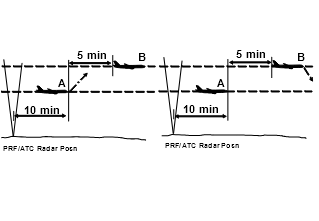
T1a 5 min | Aircraft cruising, climbing or descending | 1. B1, B2 or B3 has maintained and will continue to maintain an IAS at least 30 kt greater than A. 2. 5 minute separation has been established by the passage of both aircraft over the same positive radio fix, or the same radar position observed by ATC. 3. One aircraft maintains level while vertical separation does not exist. 4. The vertical separation at the commencement of the level change does not exceed 4 000 ft. |
| |||||
T1b 5 min | Aircraft climbing or descending, where:
2. the following aircraft climbs through the level of a preceding aircraft | 1. No closing speed (IAS or Mach No) exists. 2. The 5 minute separation has been established by the passage of both aircraft over the same positive radio fix, or the same radar position observed by ATC. 3. The level change is commenced within 10 min of the time the second aircraft passed over the positive radio fix, or the radar position observed by ATC. 4. One aircraft maintains level while vertical separation does not exist. 5. The vertical separation at the commencement of the change does not exceed 4 000 ft. |
| |||||
T1c 5 min | Aircraft cruising in a continuation of Departure Standard D4 | The cruising IAS of the following aircraft is at least 10 kt less than and not more than 90% of the cruising IAS of the preceding aircraft. |
| |||||
T2 10 min | Aircraft cruising, climbing or descending | Frequent determination of position and speed is possible by: 1. use of navigation aids; or 2. use of LRNS (INS/IRS min. G/S 300 kt) or DME on the route sections within: (a) CTA; or (b) OCA as described below: (i) BN VOR – 350 BN (outbound); or (ii) all routes contained in the airspace bounded by: SY VOR – BN VOR – LHI NDB and Lord Howe –Sydney routes; or (iii) PH VOR – 350 PH (outbound); or (iv) POKIP – EGAVI (northbound); or 3. position reports from RNP10 & RNP4 approved aircraft; or 4. visual reference to the ground by day (or night for VFR aircraft). |
| |||||
T3 15 min | Aircraft cruising, climbing or descending, within all CTAs and OCAs except when T2 is applicable |
|
| |||||
T4 10 min Mach No. Technique | Aircraft cruising, climbing or descending | The Mach Number Technique is used between aircraft: (a) on the same track and the aircraft have reported over a common point and 10 min will be maintained until another form of separation is established; or (b) on converging tracks and it is confirmed that 10 min separation will exist at the point the aircraft enter lateral conflict and 10 min separation will be maintained until another form of separation is established. | Difference in Mach No | Distance to fly and separation (in min) required at entry point | ||||
000–600 NM | 601–1200 NM | 1201–1800 NM | 1801–2400 NM | 2401–3000 NM | ||||
0.01 | 11 | 12 | 13 | 14 | 15 | |||
0.02 | 12 | 14 | 16 | 18 | 20 | |||
0.03 | 13 | 16 | 19 | 22 | 25 | |||
0.04 | 14 | 18 | 22 | 26 | 30 | |||
0.05 | 15 | 20 | 25 | 30 | 35 | |||
0.06 | 16 | 22 | 28 | 34 | 40 | |||
0.07 | 17 | 24 | 31 | 38 | 45 | |||
0.08 | 18 | 26 | 34 | 42 | 50 | |||
0.09 | 19 | 28 | 37 | 46 | 55 | |||
0.10 | 20 | 30 | 40 | 50 | 60 | |||
T5 9–5 min Mach No. Technique
| Aircraft cruising, climbing or descending where opening speed exists using the Mach Number Technique | 1. Radar observation or passage over the same, on-track, positive radio fix confirms that the required time interval will exist at the common point. 2. The preceding aircraft is maintaining a greater Mach number than the following aircraft, in accordance with the adjacent table. | Time | Mach No | ||||
9 min | Mach 0.02 faster | |||||||
8 min | Mach 0.03 faster | |||||||
7 min | Mach 0.04 faster | |||||||
6 min | Mach 0.05 faster | |||||||
5 min | Mach 0.06 faster | |||||||
For T4 and T5, a common point is: (a) a geographical point on the track over which both aircraft will fly; or (b) a point along the individual track of each aircraft that is equidistant from the geographical point described in paragraph (a). | ||||||||
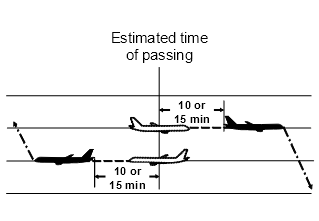
T6 10 or 15 min Aircraft on Reciprocal Tracks | Aircraft on reciprocal tracks | 1. If lateral separation is not provided, vertical separation must be provided for at least 10 or 15 min, as applicable to the route (see T2 and T3 conditions), before and after the time the aircraft are estimated to pass, or are estimated to have passed. 2. In addition to the T2 conditions for application, the 10 minute time minimum may also be applied between aircraft equipped with approved LRNS. |
| |||||
T7a Definite Passing (radio fix) |
| Both aircraft report passing the same positive radio fix. |
| |||||
T7b Definite Passing (visual fix) |
| 1. Both aircraft report passing the same visual fix, by day, or by night if both aircraft are NIGHT VFR. 2. The visual fix must be a prominent topographical feature within 10 000 ft of the levels of each aircraft. |
| |||||
T7c Definite Passing (sight and pass) |
| 1. Both aircraft report sighting and passing the other by day (and in OCA by night). 2. Both aircraft are above FL 125. 3. ATC ensures there is no possibility of incorrect identification by either aircraft. |
| |||||
T7d Definite Passing (radar observed) |
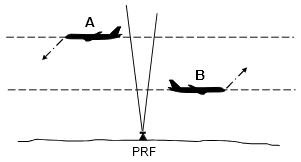
| Aircraft are observed by radar to have definitely passed. |
| |||||
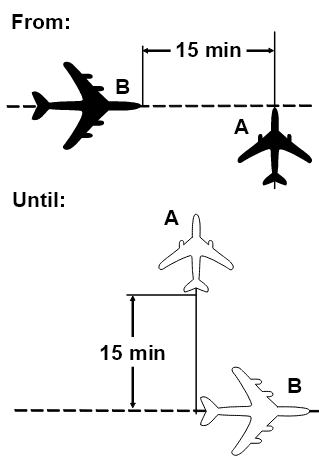
T8a 15 min Crossing Tracks | 15 min exists at the crossing point | 1. Each aircraft must have at least 1 of the following LRNS approvals: (a) NAV/AUSEP; (b) NAV/GPSOCEANIC; (c) NAV/GPSRNAV (within Australian Domestic Airspace); (d) MNPS; (e) RNP10; (f) RNP4. 2. Relevant aircraft must have a groundspeed of at least 300 kt. 3. For T8b only: Vertical separation must exist from 15 min before the estimate for B at the intersection, until 15 min after A has passed the intersection. |
| |||||
T8b 15 min Crossing Tracks | 15 min does not exist at the crossing point |
| ||||||





[10] Subsection 10.6.7.4
substitute
10.6.7.4 A DME beacon may be taken to be co-sited with a waypoint or the azimuth navigation aid providing tracking guidance only when the DME site is located within 600 m of the waypoint or azimuth aid.
[11] After subsection 10.6.7.5
insert
10.6.7.5A If a mix of DME and LRNS distances is being used:
(a) LRNS distance information must be based on the coordinates of the en route tracking aid, and not on the location of the DME site; and
(b) LRNS derived distance may be used for longitudinal separation only when the en route tracking aid and DME are co-sited.
[12] Subsections 10.6.9.2, 10.6.9.3, 10.6.10 and 10.6.11
substitute
10.6.9.2 RNAV minima must not be applied after pilot advice of:
(a) operation of LRNS equipment outside prescribed criteria, including deterioration or failure; or
(b) operation of an INS/IRS outside the time limits mentioned in the operational approval:
(i) CTA — 5 hours multiple sensor or 3 hours single sensor; or
(ii) OCA — 12 hours multiple sensor, 5 hours single sensor or 4.5 hours MNPS; or
(c) continuous operation of GPSRNAV equipment in the DR mode for at least 1 minute or non-RAIM operation for at least 10 min.
10.6.9.3 If there is concern that the update criteria mentioned in paragraphs 10.6.9.2 (a) and (b) may not be met throughout the application of an RNAV standard, the time of the last update must be obtained from the pilot.
10.6.9.4 All aircraft indicating either RNP10 or RNP4 approval in the flight notification [R in field 10a] are eligible for the application of AUSEP related separation standards providing other relevant conditions are met.
10.6.9.5 Separation based on RNP approval may only apply in RNP airspace.
10.6.9.6 The application of Lateral Separation using the Expanding Formulae for RNP10 or RNP4 approved aircraft requires carriage of INS/IRS.
10.6.10 Longitudinal Distance Separation Using ADS-C
10.6.10.1 When using ADS-C reports from FANS-1/A aircraft as the sole means of establishing and monitoring longitudinal distance separation standards, only those standards specifically identified as being approved for ADS-C may be used.
10.6.10.2 Methods of determining longitudinal distance separation using ADS-C may include:
(a) the use of system tools to measure the distance between the displayed positions of 2 or more FANS-1/A aircraft reporting by ADS-C; or
(b) when both aircraft are within CTA — a comparison of the actual ADS-C report symbol of a FANS-1/A aircraft with the position of another aircraft determined by an alternative form of surveillance, such as radar, voice or CPDLC reports.
10.6.10.3 All system tool tolerances must be taken into account in any measurement.
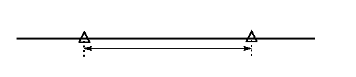
10.6.10.4 When 2 FANS-1/A aircraft reporting by ADS-C are flying on identical same tracks (same or opposite direction), the measurements may be taken directly between the 2 ADS symbols:
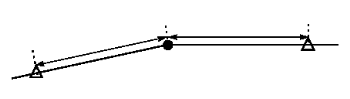
10.6.10.5 For a bend in track, the measurements may only be taken between each symbol and the turning point, not between the 2 symbols:
10.6.10.6 If 2 FANS-1/A aircraft are flying on diverging or converging route clearances, then measurements may be either to or from a common point on the route clearances:

or taken from where the abeam position of 1 aircraft intersects the route of the other.

10.6.10.7 When longitudinal distance separation is to be determined between FANS-1/A and non-FANS-1/A aircraft:
(a) the measurement may only be commenced after receiving an ADS-C report from the FANS-1/A aircraft; and
(b) the request for the voice report must be made as soon as possible after the ADS-C report symbol is displayed; and
(c) this procedure may only be used when a distance greater than the minimum of the applicable standard is available.
10.6.10.8 When comparing an ADS-C report symbol from a FANS-1/A aircraft with a voice report from another aircraft, the measurement from or to the ADS-C symbol must be taken with reference to the beacon or waypoint reported by the other aircraft.
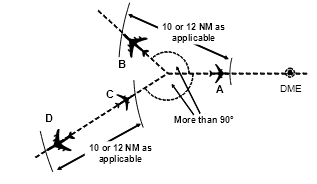
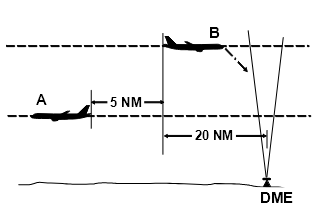
10.6.11 Distance Separation Minima
Minima | Application | Conditions | Diagram |
D1 20 NM | Climbing (for aircraft on climb to cruise) | 1. Separation must be checked at sufficient intervals to ensure minimum separation is maintained. 2. Where B is climbing to a lower cruising level or both aircraft are climbing to levels which are not vertically separated, both A and B must report reaching their cruising levels. 3. If aircraft B reports at cruising level first, immediate action must be taken to apply an alternative standard. 4. Distance information must be derived from: (a) DME; or (b) in CTA only: (i) GPSRNAV; or (ii) GPSOCEANIC. |
|
D2 20 NM | Cruising (at levels not vertically separated) | 1. Separation must be checked at sufficient intervals to ensure that minimum separation is maintained. 2. Distance information must be derived from: (a) DME; or (b) in CTA only: (i) GPSRNAV; or (ii) GPSOCEANIC. |
|
D3 20 NM | Arriving aircraft | 1. Separation must be checked at sufficient intervals to ensure minimum separation is maintained. 2. Distance information must be derived from: (a) DME; or (b) in CTA only: (i) GPSRNAV; or (ii) GPSOCEANIC. |
|
D4A 15 NM | Change of level | 1. One aircraft must maintain level flight while vertical separation does not exist. 2. Distance information must be derived from: (a) DME; or (b) in CTA only: (i) GPSRNAV; or (ii) GPSOCEANIC. 3. When using DME-derived information for level changes above FL 290, both aircraft must be on the same side of the DME beacon. |
|
D4b 15 NM | Change of level Also applicable if B is on the safe side of the aid at the commencement of level change | 1. Non-DME B1 or B2 descending/climbing while A or C maintain level. 2. Distance information must be derived from: (a) DME; or (b) in CTA only: (i) GPSRNAV; or (ii) GPSOCEANIC. |
|
D4c 15 NM | Change of level Also applicable if B is on the safe side of the aid at the commencement of level change | 1. A1, A2 or C1, C2 climbing or descending while non-DME B maintains level. 2. Distance information must be derived from: (a) DME; or (b) in CTA only: (i) GPSRNAV; or (ii) GPSOCEANIC. |
|
Notes: 1. In 4a, 4b and 4c, if the distance obtained is close to the minimum, then consideration must be given to a descending aircraft being faster than the cruising aircraft, or a climbing aircraft being slower than the cruising aircraft. Speed restrictions/requirements may be used to ensure the standard is maintained. 2. In 4b and 4c where the position of one aircraft is determined by radar, the applicable radar standard must be added. | |||
D4d 15 NM | Leading aircraft descending through level of following climbing aircraft Also applicable if B is on the safe side of the aid at the commencement of level change
| 1. The leading aircraft A is descending through the level of C (climbing). 2. DME distances must be checked in sufficient time to ensure vertical separation is maintained if insufficient distance exists to apply this standard. 3. Distance information must be derived from: (a) DME; or (b) in CTA only: (i) GPSRNAV; or (ii) GPSOCEANIC. 4. When using DME-derived information for level changes above FL 290, both aircraft must be on the same side of the DME beacon. |
|
D4e 15 NM Arriving Aircraft | Inbound aircraft to a controlled aerodrome | 1. Both A and B are inbound aircraft and the leading aircraft A is within 30 NM of a controlled aerodrome with DME. 2. The aircraft are assigned levels which are vertically separated. 3. Distance information must be derived from: (a) DME; or (b) in CTA only: (i) GPSRNAV; or (ii) GPSOCEANIC. |
|
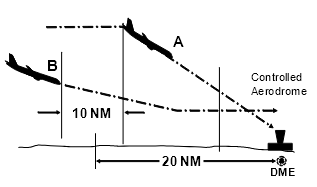
D5 10 NM Arriving Aircraft | Change of level | 1. Both A and B are inbound aircraft and the leading aircraft A is within 20 NM of a controlled aerodrome with DME. 2. The aircraft are assigned levels which are vertically separated. 3. Both aircraft are DME equipped. |
|
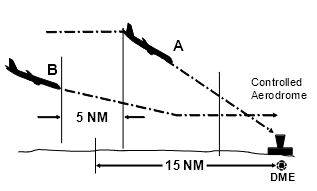
D6 5 NM Arriving Aircraft | Change of level | 1. Both A and B are inbound aircraft and the leading aircraft A is within 15 NM of a controlled aerodrome with DME. 2. The aircraft are assigned levels which are vertically separated. 3. Both aircraft are DME equipped. 4. Wake turbulence standards are applied. |
|
D7 A DME distance proportional to the rate of closure (IAS) as determined from the following DME separation tables for aircraft rate and amount of level change | Change of level Also applicable if a non-DME equipped aircraft is on the safe side of the aid at the commencement of level change | 1. One aircraft maintains level while vertical separation does not exist. 2. DME distances are checked when the aircraft are vertically separated by the minimum amount appropriate to the DME table to be used. 3. The level change is commenced within 1 minute of obtaining DME distances. When the separation is on the minimum, instructions must be issued to ensure that the level change is commenced within this time. 4. Where the position of 1 aircraft is determined by radar, the applicable radar standard must be added. 5. When using DME-derived information for level changes above FL 290, both aircraft must be on the same side of the DME beacon. 6. When applying this standard to an aircraft transiting the transition level and the Area QNH is higher than 1013 HPa, 1 000 ft must be added to the amount of level change and the applicable value in the table must then be utilised (eg for a 3 000 ft level change, use 4 000 ft table) |
|
| |||
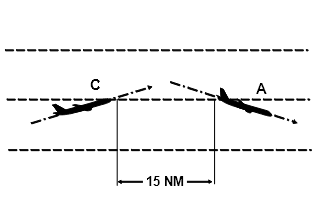
D8a Definite Passing 10 NM | Reciprocal tracks and tracks differing by more than 90 degrees | Reports indicate that the aircraft have passed and DME distance is opening. |
|
D8b Definite Passing 5 NM | Reciprocal tracks | 1. Reports indicate that the aircraft have passed and DME distance is opening. 2. One aircraft is within 20 NM of the DME beacon. |
|
D8c Definite Passing 10 NM | Reciprocal tracks | 1. Reports by reference to a prominent topographical feature by 1 aircraft and a DME beacon by the other aircraft indicate that the aircraft have passed by at least 10 NM. 2. The non-DME equipped aircraft passes over and within 10 000 ft of the topographical feature. 3. The topographical feature together with its distance from the DME beacon is specified in local Instructions. |
|
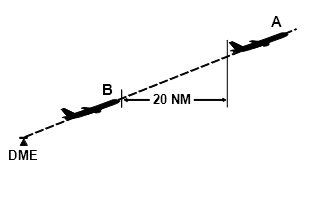


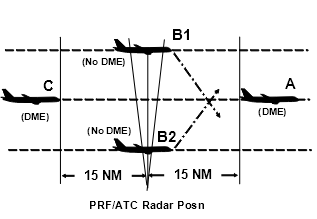





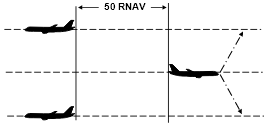
10.6.12 RNAV Distance Separation Minima
Minima | Application | Conditions | Diagram |
R1 20 RNAV | Departing aircraft on climb to vertically separated cruising levels | 1. Where B is climbing to the lower level, both A and B must report reaching their cruising levels. 2. If B reports at the cruising level first, immediate action must be taken to apply an alternative standard. 3. May only be used in CTA. 4. Aircraft must be approved: (a) AUSEP; or (b) GPSRNAV; or (c) GPSOCEANIC; or (d) RNP10; or (e) RNP4. |
|
R2 20 RNAV | Definite Passing | 1. Using the same waypoint, reports indicate that the aircraft have passed and the distance between them must be opening. 2. Whenever a DME derived distance is 30 NM or less, a correction for DME Slant Range Error must be applied. 3. May only be used in CTA. 4. Aircraft must be approved: (a) AUSEP; or (b) GPSRNAV; or (c) GPSOCEANIC; or (d) RNP10; or (e) RNP4. |
|
R3 30 RNAV | Climbing, cruising or descending | 1. When both aircraft are climbing to non-vertically separated levels: (a) both A and B must report reaching their cruising levels; and (b) if B reports at the cruising level first, immediate action must be taken to ensure separation is maintained. 2. May only be used in CTA. 3. Aircraft must be approved: (a) AUSEP; or (b) GPSRNAV; or (c) GPSOCEANIC; or (d) RNP10; or (e) RNP4. 4. When using DME-derived information for level changes above FL 290, both aircraft must be on the same side of the DME beacon. |
|
R4 50 RNAV | Aircraft cruising, climbing or descending on same track | 1. Separation must be established by reference to the same ‘on-track’ waypoint, whenever possible ahead of both aircraft or by use of ADS-C. 2. Distance reports obtained by CPDLC must be sent by both aircraft at the same time or from the leading aircraft first. 3. When aircraft are at, or expected to reduce to, the minimum, speed control techniques, including assigning Mach number, must be applied to ensure that the minimum distance exists throughout the period of application of the standard. 4. If an aircraft fails to report its position within 3 min, immediate action must be taken to establish communication. If communication is not established within 8 min from the time the report should have been received, an alternative form of separation must be applied. 5. Both aircraft must be approved either RNP10 or RNP4. 6. Subject to subsection 10.6.7.11, distance reports must be obtained at least every 24 min. |
|
R5 50 RNAV | Definite Passing | 1. Reports (including ADS-C reports) must indicate that the aircraft have passed and the distance between them is opening. 2. Both aircraft must be approved either RNP10 or RNP4. |
|
R6 80 RNAV Mach No. Technique | Aircraft cruising, arriving and changing levels when not vertically separated | 1. No closing Mach number may exist. 2. The Mach Number Technique (MNT) must be applied during the application of the standard. 3. Aircraft must be approved: (a) AUSEP; or (b) GPSOCEANIC; or (c) MNPS. Note: The requirement for ‘no closing’ may not be waived. |
|
R7 80 RNAV Definite Passing |
| 1. Using the same waypoint, reports must indicate that the aircraft have passed and the distance between them is opening. 2. Aircraft must be approved: (a) AUSEP; or (b) GPSOCEANIC; or (c) MNPS. |
|


10.6.13 Distance Separation minima using RNAV with Automatic Dependent Surveillance - Contact
Minima | Application | Conditions | Diagram |
A1 50 RNAV using ADS-C | Aircraft cruising, climbing or descending on same track | 1. Separation must be established in accordance with subsection 10.6.10. 2. When aircraft are at, or expected to reduce to, the minimum, speed control techniques, including assigning Mach number, must be applied to ensure that the minimum distance exists throughout the period of application of the standard. 3. If an ADS-C periodic report is not received within 3 min of the time it should have been sent, action must be taken to establish communication. If communication is not established, or a periodic report is not received within 8 min from the time the periodic report should have been received, an alternative form of separation must be applied. 4. Both aircraft must be approved either RNP 10 or RNP 4. 5. Subject to subsection 10.6.7.11, distance or periodic ADS-C reports must be obtained at least every 24 min. |
|
A2 50 RNAV using ADS-C | Definite passing | 1. ADS-C reports must indicate that the aircraft have passed and the distance between them is opening. 2. Both aircraft must be approved either RNP 10 or RNP 4. 3. Before the application of this standard, a Demand Contract Request (One shot) must be transmitted to each aircraft concerned. |
|

[13] Subsection 10.7.1.2
substitute
10.7.1.2 If the base of CTA is a VFR level, levels assigned to IFR aircraft must provide a buffer of at least 500 ft with the base of CTA. If it is known that an IFR aircraft is operating less than 500 ft below the CTA base, levels assigned must provide a buffer of at least 1 000 ft with the base of CTA.
[14] After subsection 10.7.6.2
insert
10.7.6A Vertical Separation Using ADS-C
10.7.6A.1 A tolerance of ± 200 ft must be applied to ADS-C level information.
10.7.6A.2 ADS-C level information may be used for the application of vertical separation if:
(a) the reported ADS-C level is FL 130 or above; and
(b) displayed ADS-C level information is within the specified tolerance of the expected or cleared flight level.
10.7.6A.3 An aircraft cleared to leave a level is taken to have commenced its manoeuvre and vacated the previously occupied level when the ADS-C-derived level information indicates a change of more than 200 ft in the anticipated direction from its previously assigned level.
10.7.6A.4 If displayed ADS-C level information for an aircraft maintaining a level does not conform to the required tolerance, the controller must send a demand contract request to update the level displayed.
10.7.6A.5 If, following the update, the level is still beyond the required tolerances, the pilot must be advised accordingly and requested to confirm the aircraft’s level. If, following confirmation of the level, the displayed ADS-C level information is still beyond the required tolerance, another method of separation or another method of determining level information must be applied.
[15] Subsection 10.7.10
substitute
10.7.11 Vertical Separation Minima
Minima | Application | Conditions | Diagram |
V1 500 ft | 1. Between IFR and VFR flights; or 2. between SVFR flights, where SVFR clearance is due to visibility | 1. Both aircraft are 7 000 kg MTOW or less. 2. Both aircraft are at or below 10 000 ft. 3. Traffic information is provided to the IFR flight, unless it is impracticable. |
|
V2 1 000 ft | All aircraft | Up to and including FL 290. |
|
Aircraft with RVSM approval, except military formation flights operating in airspace in which a Class A service is being provided | From FL 290 to FL 410 inclusive. | ||
V3 2 000 ft | 1. Between aircraft, when at least 1 is not RVSM approved, or 2. following pilot report of an inability to comply with RVSM, or 3. military formation flights regardless of the individual RVSM approval state of each aircraft within the formation
| From FL 290 to FL 410 inclusive. |
|
All aircraft | Above FL 410. | ||
In known standing wave conditions or severe turbulence | All levels. | ||
V4 3 000 ft | When 1 or more aircraft is operating at supersonic speeds | All levels. |
|


[16] Subsection 10.8.2.3
substitute
10.8.2.3 Aircraft transiting into an airspace in which larger tolerances are applied than that being exited are taken to be separated if:
(a) the smaller separation standard exists; and
(b) the aircraft are established on flight paths that will diverge by at least 15° until the larger separation standard is established; and
(c) the aircraft are RNAV approved to AUSEP, MNPS, GPSOCEANIC, RNP10 or RNP4.
[17] Subsection 10.9.4.2
omit
10.6.11
insert
10.6.13
[18] Subsection 10.10.2.3
substitute
10.10.2.3 When aircraft are operating visually as aerodrome traffic ATC must issue 1 or more of the following:
(a) clearances designed to maintain separation;
(b) sequencing instructions;
(c) relevant traffic information.
[19] Subsection 10.12.2
substitute
10.12.2 Wake Turbulence Separation Minima
10.12.2.1 Time-based wake turbulence separation minima
Full Length operations | |||
Aircraft Categories | Separation Minima | ||
Leading aircraft | Following | Departure (Minutes) | Arrival (Minutes) |
HEAVY | HEAVY (MTOW > 200 000 kg) | 1.5 | 1.5 |
HEAVY | 2 | 2 | |
MEDIUM | 2 | 2 | |
LIGHT | 2 | 3 | |
MEDIUM | LIGHT | 2 | 2.5 |
| |||

Intermediate Departures | |||
Aircraft Categories | Separation Minima | ||
Leading aircraft | Following aircraft | (Minutes) | Application |
HEAVY | HEAVY | 2 | Intermediate Departures minima must be applied when a following aircraft will commence take-off from an intermediate point more than 150 m after the take-off commencement point of the preceding aircraft, using the same runway. |
MEDIUM | 3 | ||
LIGHT | 3 | ||
MEDIUM | LIGHT | 3 | |
| |||

Displaced Landing Threshold | ||
Aircraft Categories | Separation Minima | |
Arriving aircraft | Departing aircraft | (Minutes) |
HEAVY | MEDIUM | 2 |
LIGHT | 2 | |
MEDIUM | LIGHT | 2 |
| ||

Opposite Direction | ||
Aircraft Categories | Separation Minima | |
HEAVY | MEDIUM | 2 |
LIGHT | 2 | |
MEDIUM | LIGHT | 2 |
| ||
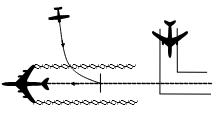
10.12.2.2 Distance-based wake turbulence separation
Distance-based wake turbulence separation | ||
Aircraft Categories | Separation Minima | |
Leading aircraft | Following aircraft | (NM) |
HEAVY | HEAVY (MTOW > 200 000 kg) | 3 |
HEAVY | 4 | |
MEDIUM | 5 | |
LIGHT | 6 | |
MEDIUM | LIGHT | 5 |
| ||

[20] Subsections 10.12.3.1, 10.12.3.2 and 10.12.3.3
substitute
10.12.3.1 Subject to subsection 10.12.3.3, wake turbulence separation minima must be applied in all controlled airspace when:
(a) an aircraft is operating within 0.5 NM laterally, or crossing behind another aircraft’s flight path, at the same level or less than 1 000 ft below; and
(b) a LIGHT, MEDIUM or HEAVY aircraft follows a HEAVY aircraft, or a LIGHT aircraft follows a MEDIUM aircraft, and their projected flight paths are expected to cross.
10.12.3.2 Wake turbulence separation minima must be applied to aerodrome traffic when:
(a) both aircraft are using the same runway for take-off or for landing; or
(b) an aircraft taking-off behind a landing heavier wake turbulence category aircraft is expected to become airborne before the touchdown point of the landing aircraft; or
(c) an aircraft is taking-off and a preceding departing aircraft on a crossing runway has rotated at or before the runway intersection; or
(d) an aircraft is landing and could still be airborne at the intersection of a crossing runway and a preceding departing aircraft on that crossing runway has rotated at or before the intersection; or
(e) a LIGHT aircraft during its landing run will cross the intersection of a crossing runway behind a departing HEAVY aircraft on that crossing runway which has rotated at or before the intersection; or
(f) using parallel runways for approach and departures when the runways are separated by less than 760 m; or
(g) an aircraft is using the opposite direction runway for take-off or landing to a heavier category aircraft that has taken off or executed a missed approach.
10.12.3.3 Wake turbulence separation is not required:
(a) when a LIGHT aircraft will cross the track or follow the track of a MEDIUM fixed-wing aircraft of less than 25 000 kg MTOW; or
(b) for VFR flights operating in Class D airspace, except in the application of landing or departure separation; or
(c) between an aircraft landing behind an aircraft taking off on the same runway, except as required by paragraph 10.12.3.2 (b); or
(d) if a pilot has advised ACCEPT WAIVER on departure; or
(e) if visual separation has been assigned to the pilot, in situations other than between:
(i) departing aircraft; or
(ii) aircraft on final approach to the same runway where ATC must ensure that the appropriate wake turbulence minima are applied at the landing threshold.
10.12.3.3A A waiver must not be applied when a LIGHT or MEDIUM fixed wing aircraft:
(a) will commence take-off behind a HEAVY aircraft from a point along the runway more than 150 M beyond where the HEAVY aircraft commenced its take-off roll; or
(b) will take-off using the opposite-direction runway to a HEAVY aircraft that has taken-off or made a low or missed approach.
[21] Subsection 10.13.4.1
substitute
10.13.4.1 If an aircraft, person or vehicle within the runway strip on a controlled aerodrome is likely to be overflown by an aircraft making a training approach, the controller must:
(a) instruct the training aircraft not to descend below:
(i) the relevant minimum altitude for the approach; or
(ii) for a practice visual approach — not below 300 ft AGL; and
(b) pass traffic information to the other aircraft before it enters the flight path over which the approaching aircraft will fly; and
(c) pass traffic information to persons, including the drivers of vehicles, operating within the runway strip of the runway to be overflown by the aircraft, other than persons operating within the works area associated with a displaced threshold.
[22] Subsections 10.13.5.3 and 10.13.5.4
substitute
10.13.5.3 Active participation in LAHSO is available only to pilots of aircraft in the following categories:
(a) Australian registered aircraft of performance categories A, B, or C engaged in operations conducted under a training and checking organisation approved under regulation 217 of the Civil Aviation Regulations 1988, if the operator provides Operations Manual information and certifies participating pilots for LAHSO;
(b) Australian registered aircraft of performance category A, B, or C, if the pilot holds a log book endorsement for LAHSO;
(c) Australian military aircraft in performance categories A, B, or C;
(d) foreign military aircraft in performance categories A, B, or C, if there is a letter of agreement between the relevant military authority and the ATS provider;
(e) Australian registered aircraft approved in writing by CASA.
10.13.5.4 Passive participation in LAHSO is available to pilots of aircraft in the following categories:
(a) Australian civil and military aircraft of performance category A, B and C at pilot discretion;
(b) RAAF Hawk, F111 and FA18 aircraft;
(c) foreign military aircraft, if there is a letter of agreement, between the relevant military authority and the ATS provider, that excludes foreign military aircraft of performance category D.
[23] Subsection 10.13.8.3
substitute
10.13.8.3 Separation must be provided to aircraft operating within a GAAP CTR in conditions less than VMC.
[24] Subsection 10.13.9
substitute
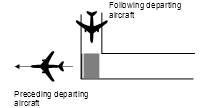
10.13.9 Runway Separation Minima
Minimum | Application | Conditions | Diagram |
Take-off behind a preceding departing aircraft | Fixed Wing Aircraft | A departing aircraft must not be permitted to commence take-off until the preceding departing aircraft: 1. has crossed the up-wind end of the runway-in-use; or 2. has commenced a turn; or 3. is airborne and has reached a point at least 1 800 m (6 000 ft) ahead of the following aircraft, the runway is longer than 1 ,800 m (6 000 ft) and the distance can be readily determined; or 4. is airborne and has reached a point at least 600 m (2 000 ft) ahead of the following aircraft, and: (a) the preceding aircraft has a MTOW of 7 000 kg or less; and (b) the following aircraft has an MTOW of less than 2 000 kg; and (c) the following aircraft is slower than the preceding aircraft; or 5. is airborne and has reached a point at least 600 m (2 000 ft) ahead of the following aircraft, and both aircraft have an MTOW of less than 2 000 kg. |
|
Take-off behind preceding landing aircraft | Fixed Wing Aircraft | The departing aircraft must not be permitted to commence take-off until the preceding aircraft has vacated and is taxiing away from the runway; and, if applicable, the appropriate wake turbulence separation has been achieved. |
|
Take-off behind landing or departing aircraft on intersecting runways | Fixed Wing Aircraft | A departing aircraft must not be permitted to commence take-off until: 1. a preceding departing aircraft on an intersecting runway has crossed the intersection; or 2. an aircraft landing on the crossing runway has either crossed the intersection or stopped short. |
|
Take-off after an aircraft has departed in the opposite direction | Fixed Wing Aircraft | A departing aircraft must not be permitted to commence take-off until: 1. the preceding aircraft has crossed the point at which the following aircraft will commence take-off; and 2. if applicable, the appropriate wake turbulence separation standard has been achieved. |
|
Take-off Helicopter | Departing Helicopter | Helicopter (1) may be cleared for take-off when a preceding departing helicopter (2) has departed the HLS, or a preceding arriving helicopter (3) has moved clear of the HLS. |
|
Landing behind a preceding landing aircraft | Fixed Wing Aircraft | A landing aircraft must not be permitted to cross the runway threshold until the preceding aircraft has vacated and is taxiing away from the runway. |
|
Landing behind preceding departing or landing aircraft | Fixed Wing Aircraft | A landing aircraft must not be permitted to cross the runway threshold unless, in the opinion of the tower controller, no collision risk exists, and: 1. the landing aircraft has an MTOW below 3 000 kg and is a Performance Category A aircraft; and 2. the preceding aircraft has an MTOW of 7 000 kg or less, and: (a) if landing, will vacate the runway without backtracking; or (b) if departing, is at least 1 000 m from the runway threshold, and has commenced its take-off run. |
|
Landing behind a preceding departing aircraft | Fixed Wing Aircraft | The landing aircraft must not be permitted to cross the runway threshold until the preceding aircraft is airborne and: 1. has commenced a turn; or 2. is beyond the point on the runway at which the landing aircraft could be expected to complete its landing roll and there is sufficient distance to enable the landing aircraft to manoeuvre safely in the event of a missed approach.
|
|
Landing after intersecting runway traffic | Fixed Wing Aircraft | The landing aircraft must not be permitted to cross the runway threshold until a preceding departing or landing aircraft on an intersecting runway has either crossed the intersection or stopped short. |
|
Landing Helicopter Landing – HLS | Helicopter | A helicopter (1) may be cleared to land when a departing helicopter (2) has left the HLS, or a preceding arriving helicopter (3) has moved clear of the HLS. |
|
Landing Helicopter Landing – Runway | Helicopter | A landing helicopter may be permitted to land when: 1. the preceding landing or departing aircraft is at least 300 m down the runway from the landing threshold; and 2. in the opinion of tower controller, no collision risk exists. |
|
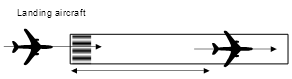
Landing behind preceding aircraft | GAAP aerodromes only | A landing aircraft may be permitted to cross the runway threshold behind a preceding aircraft, while the preceding aircraft occupies the runway, if in the opinion of tower controller no collision risk exists. |
|






[25] After subsection 11.1.5.2
insert
11.1.5.3 In Class G airspace, IFR and MLJ aircraft must be provided with traffic information on other conflicting IFR and MLJ aircraft.
11.1.5.4 In Class E airspace, flights:
(a) maintaining VFR-on-top; or
(b) operating VFR climb/descent; or
(c) using IFR Pick-up;
must be provided with:
(d) mutual traffic information:
(i) on each other; and
(ii) on IFR and MLJ flights; and
(e) traffic information on VFR flights as far as practicable.
Note Provision of traffic information is based on flight category, and not on the chosen procedure at the time of the request.
11.1.5.5 An IFR or MLJ aircraft reporting taxiing or airborne at an aerodrome within a MBZ or CTAF area must be advised of conflicting traffic which is not on the MBZ frequency or CTAF.
11.1.5.6 An IFR or MLJ aircraft inbound to an aerodrome within a MBZ or CTAF area must be advised of conflicting traffic regardless of whether the confliction will occur inside or outside the MBZ or CTAF area. The ATS obligation to provide the pilot with traffic information ceases when the pilot reports “CHANGING MBZ”, “CHANGING CTAF” or changing to the MULTICOM frequency
[26] Subsection 12.2.4.5
substitute
12.2.4.5 When being radar vectored at night, an IFR aircraft other than a HEAVY jet aircraft mentioned in subsection 12.2.4.3 may be assigned a visual approach at any distance from an aerodrome if:
(a) the aircraft has been assigned the minimum radar LSALT; and
(b) the aircraft is given heading instructions to intercept final or to position the aircraft within the circling area of the aerodrome; and
(c) the following phraseology is used to assign the visual approach:
(i) “WHEN ESTABLISHED ON THE VASIS/GLIDEPATH CLEARED VISUAL APPROACH”;
(ii) “WHEN ESTABLISHED IN THE CIRCLING AREA CLEARED VISUAL APPROACH”.
[27] Subsection 12.6.1.1
substitute
12.6.1.1 A clearance must be issued to an aircraft before it carries out:
(a) any operations in a GAAP CTRA; or
(b) any of the following operations:
(i) take-off and landing;
(ii) taxiing across or along active runways;
(iii) circuit entry;
(iv) a turn in a direction contrary to the circuit for a particular runway;
(v) circuits at an altitude different from the circuit altitude published in ERSA for a particular GAAP aerodrome;
(vi) operations on routes or at altitudes different from those published in ERSA for a particular GAAP aerodrome.
[28] Subsection 12.6.1.6
omit
[29] Section 13.1, title
substitute
Section 13.1 Weather Deviation and RVSM Contingency Procedures
[30] Subsection 13.1.1, title
substitute
13.1.1 Weather Deviation in Oceanic Airspace
[31] Subsection 13.1.1.3
substitute
Note Position may be expressed as direction and distance, or actual or estimated location or ATS route/ track code.
Schedule 2 Further amendment
(section 3)
[1] Chapter 10, renumbering
renumber the provisions mentioned in column A of the following table with the corresponding new number in column B of the table
A | B |
10.5.5.2A | 10.5.5.3 |
10.5.5.3 | 10.5.5.4 |
10.5.5.4 | 10.5.5.5 |
10.5.5.5 | 10.5.5.6 |
10.6.7.5A | 10.6.7.6 |
10.6.7.6 | 10.6.7.7 |
10.6.7.7 | 10.6.7.8 |
10.6.7.8 | 10.6.7.9 |
10.6.7.9 | 10.6.7.10 |
10.6.7.10 | 10.6.7.11 |
10.7.6A | 10.7.7 |
10.7.6A.1 | 10.7.7.1 |
10.7.6A.2 | 10.7.7.2 |
10.7.6A.3 | 10.7.7.3 |
10.7.6A.4 | 10.7.7.4 |
10.7.6A.5 | 10.7.7.5 |
10.7.7 | 10.7.8 |
10.7.7.1 | 10.7.8.1 |
10.7.8 | 10.7.9 |
10.7.8.1 | 10.7.9.1 |
10.7.9 | 10.7.10 |
10.7.9.1 | 10.7.10.1 |
10.12.3.3A | 10.12.3.4 |
10.12.3.4 | 10.12.3.5 |
10.12.3.5 | 10.12.3.6 |
10.12.3.6 | 10.12.3.7 |
10.12.3.7 | 10.12.3.8 |